

Accomplishments
Septimus Carr is an arts critic whose writings are widely allusive across literary, dramatic, and musical genres. His longform essays often blend comparative criticism with historical narrative, personal reminiscences, and a desparate, trauma-driven joke impulse.
His writings appear on Substack, Medium, Goodreads, Fable, and Reddit, where his posts score thousands of views, sometimes tens of thousands. Some of those viewers even read the articles!
Carr’s essays are informed by advanced training and workplace experience in the dramatic arts. They are also evinced by overflowing drawers of Broadway Playbills, storefront theater xeroxes, and opera house director’s notes. “His turn-ups are stuffed with ticket-stubs*.”
In past lives, Carr was published and produced as a music and film critic, journalist, and playwright. One of his short plays was once performed in direct competition with something David Mamet scribbled on a napkin. (True story, though was it really a napkin?)
Septimus continues to act as the in-house authority on Standard English Conventions for a test prep company that once serviced a large district of Chicago Public Schools.
He also wrote dozens of short essays and hundreds of dangling modifier or cause-effect inference questions for the largest test prep company in South Korea, where tests are Taken Very Seriously.
* Moon in The Real Inspector Hound by Tom Stoppard
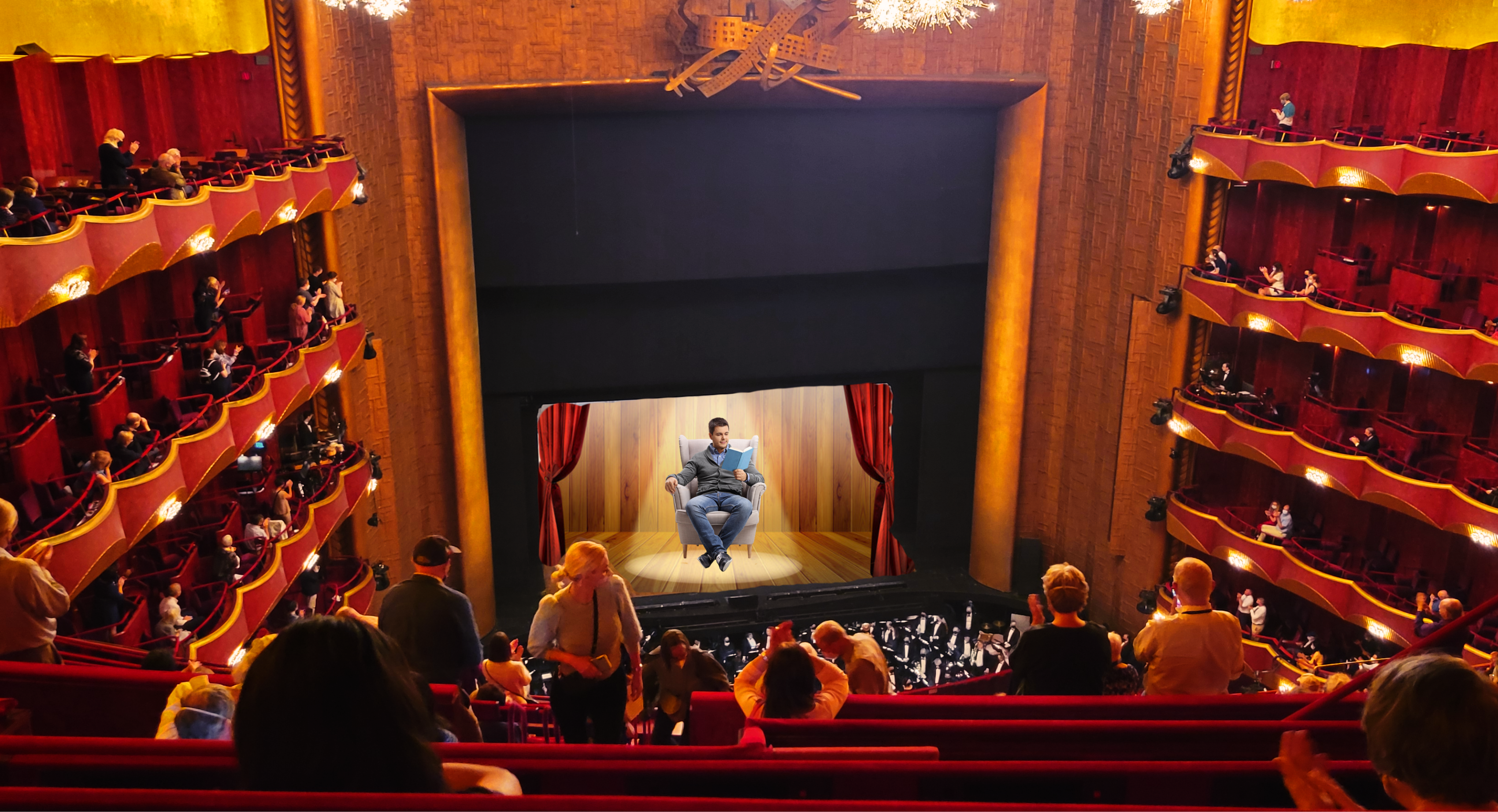
Opera house photo: AI-free composite by Septimus Carr using Canva. Photo from the Family Circle of the Metropolitan Opera by Septimus Carr. Photo of reader in chair: ID 105774812 Copyright Ljupco | Dreamstime.com Curtain and set credit ID 23147866 Copyright Frogtravel | Dreamstime.com
Beginnings
Mainstream scholarship is divided as to the precise date marking the inception of Septimus Carr’s reading career, but most point to matriculation in his local Montessori academy.
Renowned Carr specialist C.J. Effington Cottleswottle from Radcliffe University proved conclusively that Carr encountered his first consonant digraph on the second page of a red Montessori reader that was both phonics-based and decodable.
This discovery was augmented by a detailed transcript of the May 21 parent-teacher conference in which Miss Eugenie Temple reported Carr’s completion of the reader, noting that she personally had assuaged Septimus’s consternation over the difficulty of pronouncing the aforementioned consonant digraph. “’The’ is a tough one the first time you see it,” Temple reportedly told him. “But it is a very common word.”
The existing scholarship is far more conclusive on the identity of Carr’s first completed novel, J.R.R. Tolkien’s The Hobbit. Secondhand accounts suggest Carr read that book at the family’s kitchen table during a church group potluck. Guests reported that Septimus deliberately drew attention to the accomplishment by punctuating a nearby adult conversation with celebratory exclamations and fist pumps, only to recede from the room in desultory embarrassment after a church elder peremptorily intoned, “That must be a pretty exciting book.”
Other books are believed to have followed.
House AI Policy
All essay cover images on this site were prepared without the benefit of artifical intelligence. Harsh edges and clumsy editing should be chalked up to human inadequacy rather than robotic slop. Polish and gloss should be chalked up to human effort, not robotic perfection.
In the interest of full disclosure, this site will report all AI-generated images.
The Septimus Carr logo was generated by Copilot.
All other AI images that have appeared on this site at one time or another have been replaced by images created without artificial intelligence, or, some would argue, any kind of intelligence at all.
Anything that looks like AI here was probably edited using tools like Canva and, Lord Help Us, Microsoft Paint. (Canva offers some AI features; any use of them was unwitting.)
Septimus Carr recognizes that AI has legitimate uses. Autonomous writing of content is emphatically not and never has been one of them. We enjoy writing here, and we would sooner ask robots to paraglide on our behalf than accept their offers to spruce things up or jot a paragraph “in our voice.”
Bottom line: If you do not like the words chosen on any of these pages, you will have to blame centuries of biological evolution, regardless of what your clever algorithm thinks.
Let Us Show You Around The Place
We believe reading thousands of words on classic or literary fiction should be fun and informative. To that end, we have attempted to organize content in friendly ways that would confound the Dewey Decimal System. (Yes, Septimus Carr is a data geek.)
Shop for literary insight by
- Release Date
- Keyword (use the magnifying glass at the top of the screen)
- Genre
- Structure ("Multi" refers to joint reviews, a favored house form.)
- Author (one page for each essay subject, with notes on every reference made to them across all essays)
- Day / Week / Month (publication dates, reading start and end dates, personal history pertinent to the work, like every play Septimus saw in his January 1995 trip to London.)
- Year / Decade / Century (Napoleon Bonaparte takes over France! The opening performance of the Bellini opera I Puritani! The Flash’s heroic demise in the crisis on infinite earths!)
The idea is to underscore intertextual interactions. Have fun! Filter! Play! Ignore!
Up to you!