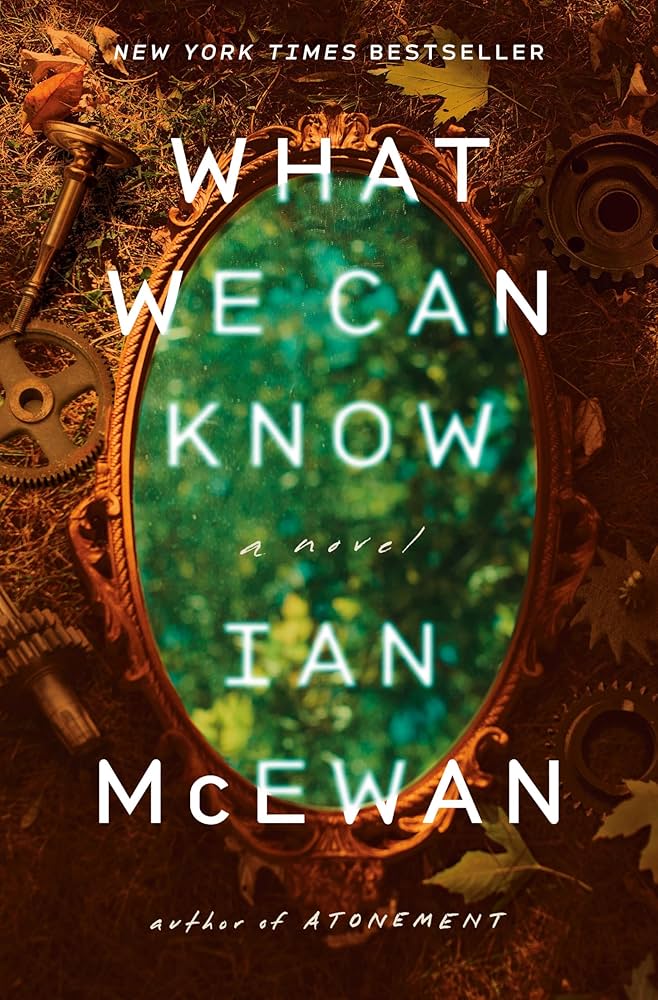

I sometimes regret not having read Ian McEwan’s 2001 novel Atonement . Director Joe Wright’s 2007 film adaptation, which I have seen, deftly explores the fine line between commonplace childhood self-absorption and casually cruel deceit with lasting consequences. It leaves an impression of masterful, must-read source material that may lose its power on the page once you’ve taken the journey on screen. That sense of missed opportunity even motivated me to check out McEwan’s Kafkaesque novella The Cockroach a couple years back, but that was, um, not a comparable experiece. When I heard that his 2025 novel What We Can Know was his best reviewed since Atonement , it made sense to grab the newcomer in hardcover before Matin Freeman and Sally Hawkins are cast as its dual narrators in some future film version. The decision paid dividends. McEwan’s tragicomic novel is a finely calibrated indictment of the present from the perspective of a compromised future.
A FUTURE WITH MORE REGRETS THAN FLYING CARS
The book is split between 2025 and 2125 (and the surrounding years), giving McEwan an opportunity to construct his own dystopian reflection of our era in the hall of mirrors of contemporary science fiction. I haven’t read enough sci-fi to rank his dystopia against all the others, but McEwan’s vision of the coming century felt like a reasonably fresh take to me. Instead of describing flying cars and hostile robot overlords, he constructs an Earth that is just beginning to work its way back to the technological accomplishments of our era.
Biodiversity, too, is starting to recover from the mass extinctions of our Holocene epoch, although the organic food supply seems beyond renewal. Future generations are loathe to forgive ours for ignoring the climate crisis, empowering reckless artificial intelligence, and mounting nuclear conflicts that apparently have their roots in Russia’s 2022 invasion of Ukraine. They are not impressed that our cultural and artistic output dwarfs theirs, and their attitude toward studying our history can be summarized by film critic Jonathan Rosenbaum’s memorable assessment of the 1995 film Carrington: “Who cares about these awful people?”
THE BIOGRAPHER’S TALE
I feel better qualified to comment on McEwan’s exploration of the futility of biography than to compare dystopias. Like many of my most cherished literary works, McEwan’s novel portrays biographers struggling to learn critical truths about their subjects. My favorite playwright, the late Tom Stoppard, was fascinated by the theme of “What We Can Know,” and he famously distrusted biography. In his 1995 play Indian Ink, a footnote-happy poetry editor effuses about the opportunities that artists afford biographers: “This is why God made poets and novelists, so the rest of us can get published.” The elderly sister of a famous poet rejoins, “biography is the worst possible excuse for getting people wrong.” Stoppard’s finest play, Arcadia, pits a Byron biographer with a galling confidence in his own “gut instinct” about 300-year-old mysteries against a colleague who relishes her own uncertainty (“If the answers are in the back of the book I can wait, but what a drag. Better to struggle on knowing that failure is final”). Stoppard admitted he had “pinched” Arcadia’s structure from A.S. Byatt’s 1990 novel Possession, one of the best books I read last year. The latter work is about a contemporary scholar who finds an uncatalogued love letter from one major Victorian poet to another in a library book, raising questions about who ultimately owns the secrets of the past. Another Byatt novel, The Biographer’s Tale, depicts a disillusioned graduate student yearning to trade the abstractions of postmodern philosophy for the tangible facts in which a biographer traffics. In this respect, What We Can Know is treading well-worn territory, even hallowed ground.
WHAT WILL OUR DESCENDENTS THINK OF US?
McEwan’s main contribution is to ask not what is knowable about yesterday, as did Stoppard and Byatt, but what will be knowable about today when tomorrow arrives. In this novel, the denizens of the present largely hold the power to choose what is remembered of their time, but their choices usually end up obscuring the very things they most wish to preserve. In this way, McEwan recalls Oscar Wilde’s aphorism that “each man kills the thing he loves.” In the novel, Francis Blundy, the most renowned poet of 2025, dreams that his poem “Corona for Vivien” (a corona is a union of several sonnets) will leave an indelible mark on the future: “Would it, could it be understood? He thought it might need footnotes, sensible, helpful ones, unlike Eliot’s at the end of The Waste Land. He believed that this work equaled or surpassed Eliot’s poem.” Yet when the future arrives, Blundy’s poem is remembered not for its literary achievements but because it seems irretrievably lost to history. Although it remains concealed from the public, rumors circulate about its contents. Based on rumor alone, the poem is celebrated as a paean to a clean environment. In reality, however, Blundy was an intransigent climate denier, the poster boy for our generation’s callousness toward our descendants. Some in the future imagine the corona was an ode to the lost art of interpersonal intimacy. Ironically, Blundy’s wife Vivien may have prevented its publication due to her own marital dissatisfaction.
PROBING OUR DISSOLUTION WITH WIT
The author presents all this moral reckoning with a light comic touch. McEwan’s breezy and confident wit provides a gently barbed send-up of academia that has more in common with the works of Michael Frayn than the dazzling wordplay of Stoppard. Imagine the characters and tone of Frayn’s novel The Trick of It, a comic romp in which a pedantic adjunct marries the novelist he teaches to undergrads, merged with the epistemological themes of his play Copenhagen, in which Werner Heisenberg’s uncertainty principle illuminates the impossibility of reconstructing the past. In one scene, McEwan narrates a poetry reading from Blundy’s perspective, and his oration leaves the audience in stunned silence. A woman wipes away tears. Then, one by one, we enter the listeners’ minds and discover that none of them were paying attention. The woman’s tears were inspired by something else entirely. In another scene, the students of the future stage a walkout of a lecture on Blundy out of righteous disgust with our generation. The superficial suavity of Vivien’s lover Harry Kitchener, whom she deliberately wounds by dating a superior writer, is itself worth the price of admission.
AN ELEGY FOR THE PRESENT
Despite its amusing veneer, What We Can Know is at its core a lament for a society incapable of sustaining itself. McEwan masterfully captures the simultaneous talent, depravity, generosity, and brutality of humanity. When he writes about a 20th century mother dropping acid while her child suffocates in its crib, he is conjuring the greed and convenience that motivate our neglect of the future. When he poignantly portrays an Alzheimer’s victim’s gradual mental disintegration, he gestures toward the loss of communal memory that humanity seems destined to endure. The central question of the book may be whether our heirs will care any more for us than we do for them. Who cares about these awful people, indeed.