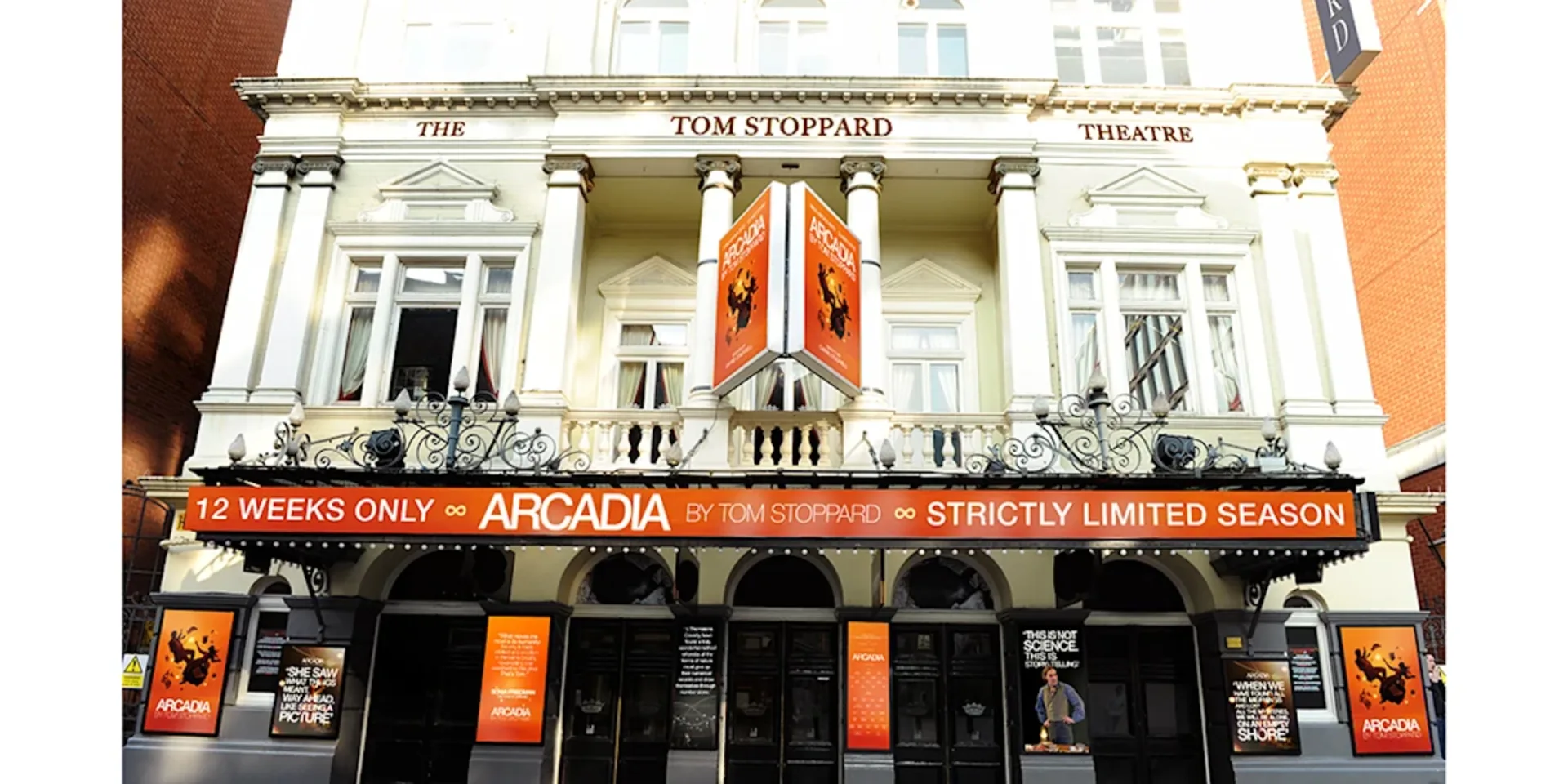

Today◆The Tom Stoppard Theatre is named on London’s West End, the Duke of York’s Theatre officially became the Tom Stoppard Theatre. The name change is timed to coincide with the opening of a new revival of Arcadia, by consensus the most ambitious and moving play by the man who was the world’s finest living playwright until his passing at 88 last◆Tom Stoppard Dies Thanksgiving week.
It’s funny how appreciation of an individual artist, particularly in youth, can leak into self-definition. Seeing the news about the Tom Stoppard Theatre pop up unbidden on my phone this afternoon triggered unearned pride tempered with a trace of ennui: I’ve never set foot in the venue that now bears the name that cloaks mine. My nom de plume as a literary essayist is derived from two of Sir Tom’s leading men: Septimus Hodge from Arcadia and Henry Carr from Travesties. This is a nod to his outsized influence in my development. His inventive wit and voracious intellect inhabit my brain cells, surfacing with embarrassing frequency in my writing. The detritus of his boundless reading life, one that frapped literature, politics, philosophy, and science into springboards for humbly stated moral wisdom, ripple within my own. The man turned me on to literature, and now he’ll never know.
WHEN I WAS A CHILD, I SPAKE AS A CHILD
Last week, I watched a surprisingly delightful 2009 promotional documentary for Rufus Wainwright’s opera Prima Donna. In it, Rufus’s mother, folk music legend Kate McGarrigle, states that pubescent boys (yes, she specified boys) tend to latch fiercely onto a life-shaping enthusiasm. For Rufus, who was born two weeks after I was, that passion was opera. Stoppard’s interests at that age were more diffuse. Cricket, Greek, and Evelyn Waugh. The latter was beginning to nudge his pen in comical directions, but Hermione Lee reports in Tom Stoppard: A Life that he was bored by the theater and that his school headmaster lamented his “lack of ‘single-mindedness.’” My own story ratifies McGarrigle’s observation. Early in my teens, I was becoming passionate about pretending to be other people onstage.
ACTING
Stoppard accompanied me on that journey, too. My first role in college was Moon in Stoppard’s comedy The Real Inspector Hound. My last was Henry Carr in Travesties, an ostentatious Stanley Cup for any actor that entailed multipage monologues as a doddering old man and pages of declamatory dialogue as a repurposed Algernon Moncrieff. When◆Travesties at Court Theatre we learned that Travesties was being staged at Chicago’s Court Theatre, the cast bundled into road-tripping sedans. The Chicago Carr was Larry Yando, to this day a regional legend with famously protean range. He generously met our effusive cast in the lobby after the show. When he asked which of us had played his role, I fought simultaneous urges to hide and to curtsy in pride. The inveterate pro looked at me conspiratorially. “You know how you never accept compliments for memorization? For this role, you accept.” I knew what he meant. After one performance, a peer said to me, “In that play we did this summer, you were still calling for lines in tech. How did you manage to learn this part?” The reality was that it had been easy. Carr’s thoughts are meandering and senile, but Stoppard’s exquisitely phrased digressions flow with inexorable logic. A year or two after graduation, I was cast as Algernon at a community theater. Stoppard had lifted so much from Wilde’s The Importance of Being Earnest that I felt like I’d already memorized the part. But as I performed those glittering lines, I found my voice did not respond to my thoughts the way it used to. I’d done those voluminous monologues in a throat-constricting old man voice. Yando had kept his voice lithe and let his body do the aging. My directing class professor, a twinkle-eyed gent who always seemed to know more about his students’ inner lives than he had any right to, sat in for one of the rehearsals. “He’ll be wonderful in this show,” he told a friend. “If he doesn’t lose his voice.” When one reviewer described my Algy as “a crashing bore,” I couldn’t help but blame the damage my Travesties choices had inflicted.
WHEN I BECAME A MAN, I PUT AWAY CHILDISH THINGS
McGarrigle’s insight about tween enthusiasm only tells part of a story that tends to twist in early adulthood. In Wainwright’s early twenties, he fused his operatic passion with melodious contemporary songcraft. Now he is primarily known as a pop star. Stoppard’s early aimlessness crystallized into purpose when he became a journalist and drama critic instead of attending university. He once told Theatre Quarterly that he began thinking about writing plays at 21. It was a common enthusiasm for his generation, he said. “Everybody of my age who wanted to write, wanted to write plays.” As for me, the thrill of acting was beginning to pale, overtaken by fascination with the things that Stoppard could do with words and ideas. The more Stoppard plays I read, the more I wanted to follow his bibliographic breadcrumbs to new authors who referenced new authors who referenced new authors. Packing wildly disparate topics into two brisk acts, as Stoppard did, began to seem nobler and grander in my estimation than enacting intention and obstacle onstage in assorted accents.
WRITING
Literary analysis was emerging as a personal strength by the time Arthur Miller’s Broken Glass took up residence in the wings of the newly minted Tom Stoppard Theatre, then still called the Duke of York’s, on February 24, 1995◆Broken Glass opens at Duke of York's . This bit of trivia is memorable to me because it was a month to the day after I concluded◆Depart Heathrow my sole London escapade. Broken Glass, then at the National Theatre, was the first performance I saw in a monthlong theatre course more chaperoned than taught by the directing class professor, who preferred to let our own fledgling perceptions do the teaching. At intermission, I was headed for concessions when he caught my eye and gestured toward the plush purple seat beside him. “What do you make of all this melodrama?” he asked grumpily. “What is Miller trying to do?” I rattled off a quick summary. The Brooklyn wife’s paralysis is brought on by personal horror over the overseas emergence of Nazism, and the self-hating Jewish husband doesn’t get it. The psychosomatic illness is the personal thread that binds personal and public morality, Miller’s signature theme. The professor looked at me thoughtfully for a moment, almost persuaded. Then he turned back toward the stage. “Maybe it is interesting intellectually. But it’s boring.”
I think the professor, who had read my prompt book essays about Stoppard’s The Real Thing for his directing course the prior year, had enough sense of my affinity for Stoppard that he deliberately assigned me the task of reviewing Arcadia. He undoubtedly had enough sense of that affinity to know the absurdly outsized weight I would feel when he singled me out in the aisles of the Haymarket Theatre, the time-suspended shimmer of the climactic double waltz still wafting through our partially formed prefrontal cortexes like matutinal mist, and sternly told me, “I think you could write like that. But it will take work.” I spent multiple subsequent hours wandering down Tottenham Court Road with my girlfriend, dissecting the play and getting foolishly rutted on a fallacious insinuation I’d seen in a gopher post that Gus’s presence in both periods, coupled with an insipid misinterpretation of chaos theory, somehow pointed to the real-world possibility of time travel. By the time I settled into work on the review assignment, there were few hours left in the morning. After I’d read it to the class, the professor said, “That’s good writing, but is there more that needs to be said? What were your favorite lines?” And the ensuing stream of cherished Stoppardian bon mots brought back vivid memories of a forgotten childhood tradition in which my brothers and I would meet on the living room trampoline the morning after a musical theater outing and quote the funniest constructions by Hammerstein or Gilbert or Loewe or whomever wrote the book for them. Some critic once wrote that audiences walk out of Stoppard plays “humming the puns.” I guess that’s what my class was doing that morning in the pub adjacent to the St. Giles Hotel. He also said, “Laughter is the sound of the audience patting itself on the back.” Guilty as charged.
NEVER MEET YOUR HEROES
The following day◆Tom Stoppard at UPenn , I got a call from my London-era ex. “He’s going to be speaking in Philadelphia,” she said. “I think we should go.” Seven hundred and fifty miles later, I lowered myself into an auditorium seat at the University of Pennsylvania. He was there for a Q&A, which was glorious. I loved the way he rolled his Rs. I loved his grounded humility. An audience member praised his use of science and called Arcadia his best play. Stoppard replied that he didn’t deserve points for his thin understanding of chaos theory or the second law of thermodynamics. “If Arcadia is my best play, and you may be right,” he said (of course I’m paraphrasing). “It’s not because I made allusions to scientific theories. It’s because the story bears the most emotional weight.” Spot on. But he also said, or maybe I read this somewhere, that the praise for his realistic dramas was frustrating because writing his early, funny ones (he once called it his “hummingbird phase”) took so much more work.
LOSS
I tried to formulate a question from a paper I’d written for my theater history class (though it was really comparative lit), “Gravely Underestimating God: Loss and Renewal of Faith in the Plays of Tom Stoppard.” The paper identified a paradigm across all his plays in which his characters’ epistemological certainty is shattered by postmodern doubt, only to be renewed in a more complex form that affirms absolute truth. The academics in Arcadia lament the futility of comprehending the past but ultimately cherish the opportunities afforded by historical ignorance. Rosencrantz and Guildenstern know nothing about their purpose in Hamlet, but their existential despair is part of a larger context in which Shakespeare is an all-knowing deity. Hapgood explores quantum uncertainty in the duplicitous world of espionage but suggests Einstein should have had more faith in a “God who throws dice.” You get the idea. The concept was largely inspired by Stoppard’s only overtly theistic play, Jumpers, but now I wish I could have added some of the later plays, like Rock ’N’ Roll and The Hard Problem, both of which exhibit human frailty but conclude that materialism is too reductive. The title was from a 1973 interview with the Rev. Joseph McCulloch that focused on Stoppard’s religious perspective. “I rather think that science and theology will always find a way to dance together to the music,” Stoppard said in a remarkable two-decade premonition of Arcadia’s closing waltz. “The higher we penetrate into space and the deeper we penetrate into the atom, all it shows to a theologian is that God has been gravely underestimated.”
I tried to find a question there, but decided my juvenile insights required too much explanation for a forum like that, and what was I going to ask? “Is this pattern really in your plays?” I flattered myself that he might have said, as he once did in The New Yorker:
“Whenever I talk to intelligent students about my work, I feel nervous, as if I were going through customs. ‘Let’s have a look in your suitcase, if you don’t mind, sir.’ And, sure enough, under the first layer of shirts there’s a pound of hash and fifty watches and all kinds of exotic contraband. ‘How do you explain this, sir?’ ‘I’m sorry, Officer, I admit it’s there, but I honestly can’t remember packing it.’”
But I stayed silent. And after the Q&A, I silently handed him the copy of Indian Ink my elder brother had given me for Christmas (“I guess I forgot to autograph it myself,” my brother said that week, seeming genuinely remorseful). Stoppard jotted his rather plain non-cursive signature as he bantered with someone behind him. I don’t think he even looked up. My other brother remembers Stoppard declaring, “I’m a rrrrromantic” to his rearward interlocutor as he signed our books and swears — or imagines — that Sir Tom gazed into his eyes as he said it. I just meekly accepted his scrawl and walked offstage to join a friend. “I would have thought you would have said something,” she said.
RENEWAL
This should probably be an ache, the way my memory of the professor’s admonition is an ache. But what would I have said? He meant so much to so many. What would my fanboy appreciation mean to him? There’s that exchange in Arcadia where Thomasina laments the incineration of the Alexandria library: “How can we sleep for grief?”
Septimus tells her, “By counting our stock. Seven plays from Aeschylus, seven from Sophocles, nineteen from Euripides, my lady! You should no more grieve for the rest than for a buckle lost from your first shoe, or for your lesson book which will be lost when you are old.”
I have his plays. That’s enough for me.
Rest in peace, Sir Tom, and long live the Tom Stoppard Theatre.