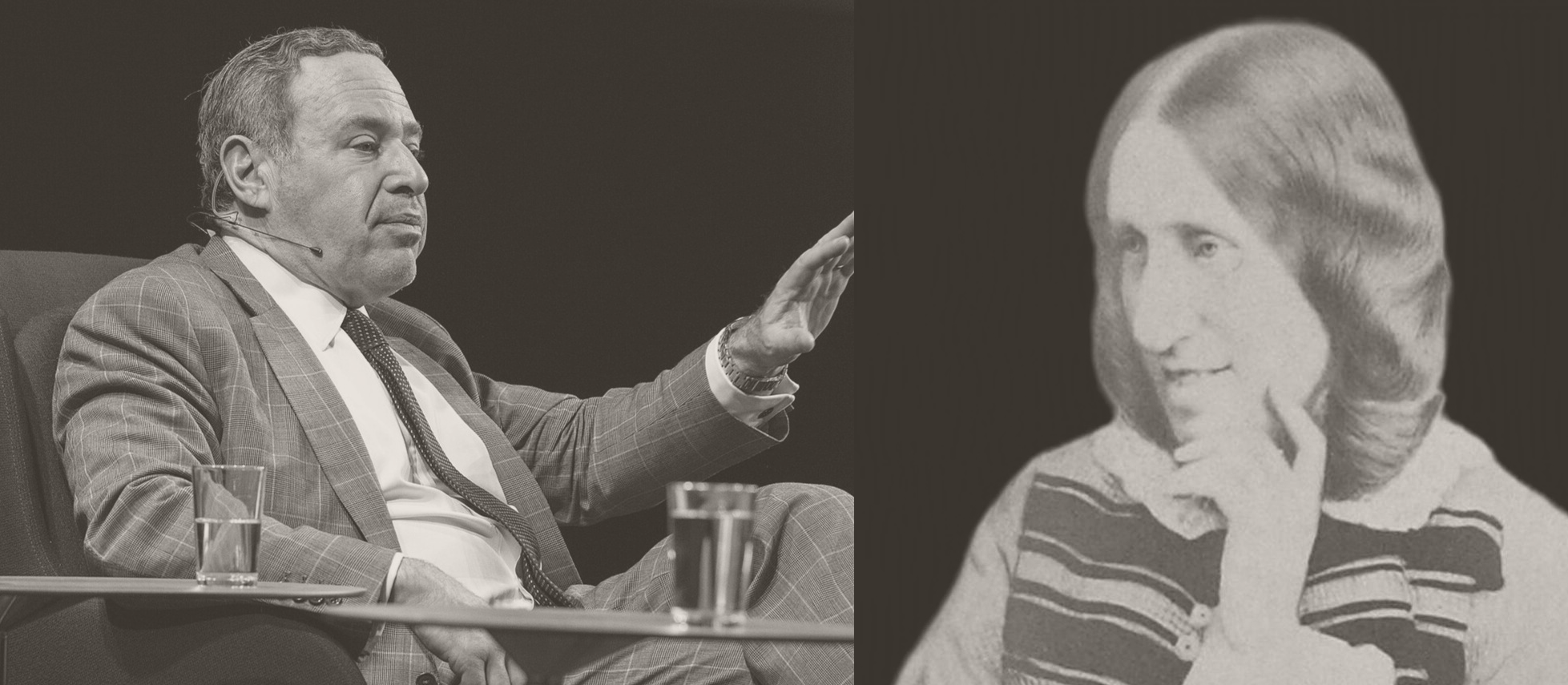
David Frum is not an expert in English Literature, but like Septimus Carr, he plays one on his blog. A longtime Atlantic contributor, former George W. Bush speechwriter, and, to his everlasting credit, a fierce interrogator of his own party and of the Trump administration, Frum writes culturally fluent, rational content that is never more entertaining than when he applies his unique perspective to classic novels. Consider me a fan.
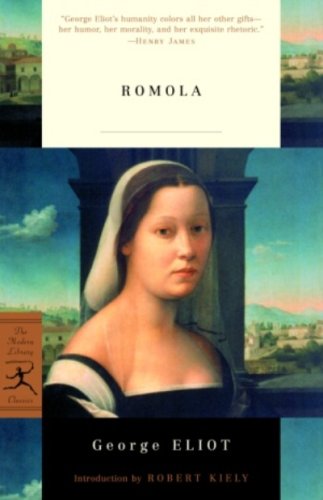
Nevertheless, my hackles made a rapid, indignant ascent when I came across an undated account of Frum’s attempt to read Romola, George Eliot’s 1862◆Romola is published, originally in serial editions historical fiction novel about 1492 Florence. After claiming inaccurately that “almost nobody” likes the book, Frum offers this blithe thesis:
I got a little more than half way through the book before I finally had to quit, beaten into submission to the majority view: “Romola” is boring and silly — Eliot’s one grand debacle as a writer. David Frum, davidfrum.com
He DNF’d it? And then panned it in print?
What follows is a not-entirely-unaltered reproduction of a message I pasted into the Contact form of Frum’s website on February 9, 2026. That Frum never responded to my message is unsurprising considering his perpetually crowded dance card. After all, Frum has serious White House credentials, secured in an era when such plaudits were not predicated on professional inadequacy, contempt for the office’s very purpose, and generally demonstrable rank incompetence. Frum is also a sought-after political commentator in outlets as ideologically disparate as The National Review, MS Now, The Times of Israel, and Süddeutsche Zeitung.
Also, he’s an abject candy-ass too craven to defend his wholly indefensible literary views.
I’m just kidding, of course.
I don’t actually know what the ideological perspective of Süddeutsche Zeitung is.
OPEN LETTER TO DAVID FRUM
Hi, David.
I greatly enjoyed your now-aging post about George Eliot’s delightful prototypical campaign drama and topsy-turvy melodrama Felix Holt, The Radical a couple of years ago, around the time I read the book myself.
So fun to get a contemporary political commentator’s analysis of a fairly obscure Eliot work. I agree with your assessment that Felix is a satisfying early effort at a Victorian political novel. Certainly, Eliot deserves credit for implicitly asking whether it was “radical” to make “rotten boroughs” (overrepresented voting districts) a little less rotten, or to call out the soft corruption of buying votes with beer. I would argue that any conversation about Victorian novelists who “show the system in action” should cite Benjamin Disraeli, who wrote more than a dozen politically sophisticated novels from an insider’s perspective laced with withering wit and compassionate conservatism. (Your old boss might approve.) But that’s a quibble. Your appreciation of Felix’s institutionally isolated matriarch Mrs. Transome was spot-on. I only wish you’d elaborated on your oblique reference to “the problems of feminism.”
All that said, you blew a wide-open layup in your evaluation of Romola. I get your frustration with the early chapters, in which the book’s semi-monastic titular heroine does echo Felix’s Esther Lyon in succumbing to a love you so aptly framed as “dangerously self-abnegating.” But you fail to acknowledge Romola’s eventual cleareyed emergence on the other side of that love and her efforts to take up arms against it. Tsk tsk. Someone didn’t complete the assignment.
Your declaration that “almost nobody has a good word to say for Romola” is either ignorant or insulting. That “almost” is a black hole of a caveat; it swallows 3,000+ Goodreads users who gave the book a 4 or 5 star rating, this one included. It also envelops no less an authority than Henry James, who called it Eliot’s “most important” work (“the one in which the largest things are attempted and grasped”) in an 1866-10◆Henry James declares Romola the most important Eliot novel. edition of Atlantic Monthly—yes, David, the publication that punches your meal ticket. James praised Romola’s “elevated morality” and suggested that its artistic merit was commensurate with its success “as a moral argument.” To be fair, it was a mixed review, but James later◆Henry James says Romola and Middlemarch were both Rare Masterpieces. offered similarly bracketed praise for Middlemarch (”[it] is a treasure-house of details, but it is an indifferent whole”), which was recently declared the single greatest offering in the history of the novel by The Guardian. In that piece, James called both books “rare masterpieces.”
You argue that Romola reads “like a worshipful guidebook.” Okay, so early on Eliot crams her exhaustive historical research into every sentence like Hermione Granger writing an admissions essay for the House of Medici. Okay, so most of her chatty Florentine characters speak a homogenous Renaissance dialect that she likely invented for this project. Okay, so the opening chapters tend to slog along like a Medicean galley through an oil spill in the Arno.
Forget all that. Before long, Eliot’s narrative pot starts boiling. She deftly begins to unfurl one of the most original love triangles in English literature. Eventually, she boldly assigns a leading role to a controversial historical figure, the fascinating friar-cum-politician Girolamo Savonarola. By the time she pits the merits and hazards of Christlike devotion and servitude against the cumulative wisdom of classical antiquity, this supposedly “boring and silly” three-volume adventure holds its own against the bulk of the Victorian canon.
Eliot’s literary calling card is her fine-tuned psychological characterizations, and `Romola has them in spades. That Romola’s two-timing husband Tito Melema, from whose perspective much of the book is told, is an antihero does not make him unique in 19th century literature. But only the progenitor of Middlemarch’s remarkably multidimensional semi-antagonist Edward Casaubon could have rendered Tito with such subtle layers. The book details his gradual decline from an earnest, goodhearted youth to a craven-but-smooth-as-silk Machiavellian sociopolitical overachiever. Eliot forecasts this fall from grace before◆Piero (The Unfortunate) de Medici beomes ruler of Florence Tito has even committed a sinful action, reporting that he has “sold his soul to evil” after he merely thinks about his reluctance to rescue his adoptive father from Muslim slavery. (It must be acknowledged here that Eliot’s depiction of so-called “Moslem conquerors” is regrettably far less nuanced than her depiction of nearly every white character in her oeuvre.) But if her early judgment of Tito seems harsh, she is less interested in condemning an evildoer than in sowing the subtle seeds of his undoing. Throughout the book, even as he contemplates murder, plots political assassinations, cheats on his wife, and seduces a childlike girl, Eliot compassionately stresses Tito’s genial nature, kind instincts, and sincere uxorious devotion. There but for grace go all of us, she suggests. She isn’t interested in mustache-twirling villains; she wants to contrast the difficult choices made by Romola with her husband’s persistent unwillingness to depart from the path of least resistance.
As remarkable in Romola as ever is Eliot’s clear-eyed moral wisdom. I’ll admit I was puzzled through much of the novel by the heroine’s, and by extension Eliot’s, obvious admiration for the severe religious zealot Savonarola. The youthful Eliot was willing to sacrifice her father’s love and subject herself to vicious gossip by openly and honestly rejecting foundational Christian doctrine. Moreover, she could not have achieved what she did as an author without the impressive breadth and depth of her reading and education—even in an era when a solid foundation of learning was a requisite of the comfortable classes. So how could Eliot be so generous in her treatment of a politically ambitious monk who willfully destroyed secular art and improbably claimed to have received prophetic visions from God Himself? The answer is that Eliot prioritized Christian compassion for society’s most vulnerable over lavish indulgence in erudition and wealth. She appreciated the way that Savonarola steered◆Friar Girolamo Savanarola takes over Florence Florence away from the depravity of the Medici toward a humanism that she still considered holy even though she had personally shed the trappings of religious belief. By the conclusion, however, Eliot distances herself (and Romola) from Savonarola’s extremism.
You might be tempted, Mr. Frum, to claim vindication when I confess that the last few chapters lack the page-turning adventure of Felix Holt’s climactic electoral riot and trial. Or that Romola offers nothing resembling the beautifully intertwined emotional climaxes of the three major romantic plots in Middlemarch. I’ll admit that I struggled a bit to get through the repetitive final pages of Romola. But a slight reduction in narrative oomph at the finish line hardly negates Eliot’s confident, artful wisdom throughout the race.
You would do well to consider studious silence as a preferable alternative to staining your corner of the eternally accessible world wide web with an underinformed mansplanation directed at one of the most revered fictionists ever to take pen to paper.
By the way, thanks for being a good sport about the preceding playful dressing down. I hope you’ll accept it in the spirit I intend: strongly but jestingly worded trash talk from a minor online literary blogger to a major one whose work he admires.
“Mansplaining” is admittedly a cheap shot. I’m sure you’d be just as patronizing if you were critiquing a male author whose book you hadn’t read.
In all seriousness, thanks for continually fighting the good fight; yours is an important political voice in dark times.
Sincerely,