“What most impresses me about [Kazuo Ishiguro] is how he changes his style with each work. That’s completely different from the way I work. I’m the type to gradually develop and evolve my style . . . But we are similar in that we both place a great importance on style.” Haruki Murakami in a 2018 interview for David Karashimas book Who We’re Reading When We’re Reading Murakami
At first glance, Japanese author Haruki Murakami◆Haruki Murakami born ’s statement about Japanese British author Kazuo Ishiguro◆Nagasaki, where the Ishiguro family resides, hit with atomic bomb seems like spot-on insight about both of their generation’s most internationally recognized authors of Japanese descent.
Certainly, Ishiguro reinvents himself with every outing, bounding from chronicler of post-war Japan (An Artist of the Floating World) to voice of the British servant class◆The Ishiguros emigrate to the United Kingdom (The Remains of the Day) to lyrical mimic of Arthurian legend (The Buried Giant) to cautionary tale-teller on the hazards of cloning (Never Let Me Go) to early adopter of AI-era angst (Klara and the Sun). But his style, which I’ll define as the formal expression of the author’s central themes, is actually more consistent than a surface inspection would imply. With the exception of 1995’s sprawling nightmare The Unconsoled, which The New Yorker’s James Wood blasted for having “invented its own category of badness,” Ishiguro is a master of compression, collapsing complex history and psychology into 250-page explosives.
Even Murakami’s self-evaluation is an oversimplification. Unquestionably, Murakami has evolved in his narrative capacities from the playful semi-superficiality of his first English-language offering, Hard-Boiled Wonderland and the End of the World, to the sophisticated fusion of magical realism, whimsy, and desolating portraiture that marks his signature works, The Wind-Up Bird Chronicle and Kafka on the Shore. But Murakami has also showed that his form can be adapted to suit a contrasting context, as with the realistic hippie memoir Norwegian Wood and the restrained jazzy impressionism of After Dark.
Killing Commendatore finds Murakami coming as close as he ever has to a direct dialogue with Ishiguro’s work. Like An Artist of the Floating World, the novel contends with the atrocities Imperial Japan committed during the war. Both books depict painters confronted with the state’s demand that they subjugate art to politics. Because of that shared starting point, the two books provide a fascinating case study for comparison. The temptation is to evaluate Murakami on Ishiguro’s terms: What does he have to say about his generation’s relationship to their parents’ embrace of Fascist values? But it turns out that the more interesting question is how both authors hold up on Murakami’s terms, as laid out in Killing Commendatore: How does an artist arrive at an Idea, and what approach best realizes that Idea?
Ishiguro’s Inquiry:
Making a Better Go of Things
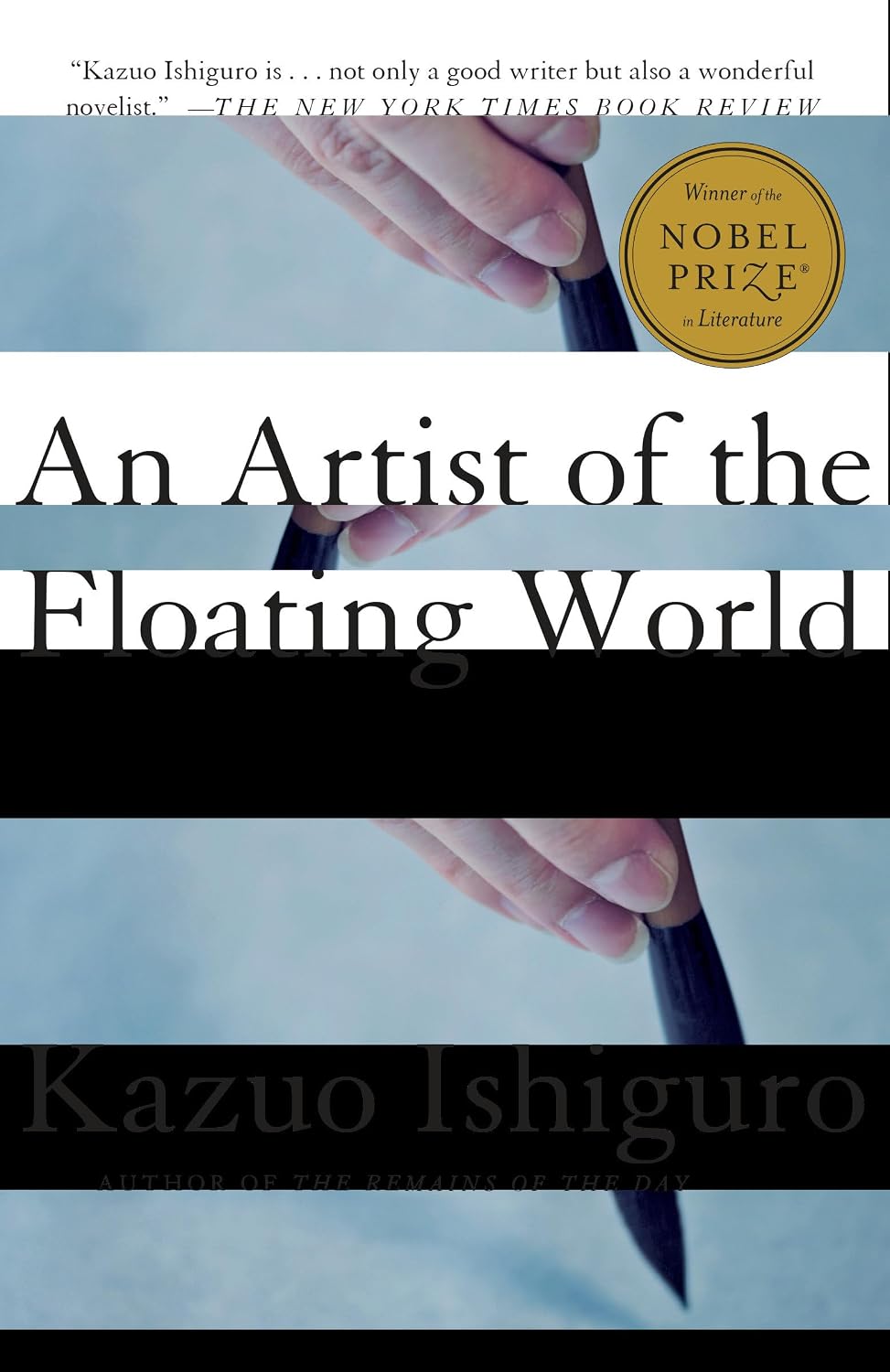
To see how our city has been rebuilt, how things have recovered so rapidly over these years, fills me with genuine gladness. Our nation, it seems, whatever mistakes it may have made in the past, has now another chance to make a better go of things. One can only wish these young people well. Narrator Masuji Ono in Kazuo Ishiguro’s An Artist of the Floating World
Ishiguro’s novel voices the rage felt by his own generation ( he was born in 1954◆Kazuo Ishiguro born in Nagasaki, Japan ) at his parents’ generation for cooperating with the expansionist Hirohito regime◆Emperor Hirohito decides to expand into Empire . The book is a cathedral where the tombstones of wartime regret resound with echoing whispers of grief. The protagonist, painter Masuji Ono, has lost his wife and son. Ono is no innocent victim, however. He let expansionist colleagues push him from meaningful art to polished propaganda. His daughter’s suitor, Jiro Miyake, channels righteous fury into polite intimations that his would-be father-in-law should simply commit suicide: “Sometimes I think there are many who should be giving their lives in apology who are too cowardly to face up to their responsibilities,” he remarks with pointed imprecision. “Some of them are no better than war criminals.”
By delegating the storytelling to the war criminal himself, Ishiguro points a silent finger of blame at the wartime generation, but this reads less as a withering indictment than as a sad statement of fact. He lets Ono mount his own defense and earns a conviction through Ono’s self-implication. In a key scene, Ono tries to teach his young grandson the right way to think about an Imperialist songwriter who killed himself after the war◆Emperor Hirohito surrenders to President Truman . He describes the decision as “brave and honourable” before immediately retracting the implied confession. “Your Oji never meant anything by saying he was like Mr Naguchi,” I said. “‘It was a sort of joke he was making, that’s all.”
Ultimately, generational guilt is not Ishiguro’s true subject; he is more concerned with exploring what guilt does to memory and identity. “I’m interested in memory because it’s a filter through which we see our lives, and because it’s foggy and obscure, the opportunities for self-deception are there,” said Ishiguro in a 2000 interview. “In the end, as a writer, I’m more interested in what people tell themselves happened than in what actually happened.”
To that end, Floating World is full of narratorial prevarications like this: “Did Miyake really say all this to me that afternoon? Perhaps I am getting his words confused with the sort of thing Suichi [his son-in-law] will come out and say. This is quite possible.” Wood has called Ishiguro’s narrators “reliably unreliable.” The truth comes through our own interpretive lens and in moments of unintended honesty. This allows Ishiguro to be brutal in his ethical verdict and compassionate in his narrative sentencing. The quotation about “making a better go of things” in future generations ends the novel on a note of intergenerational grace.
Murakami on Ishiguro’s Terms:
Historical Headfake
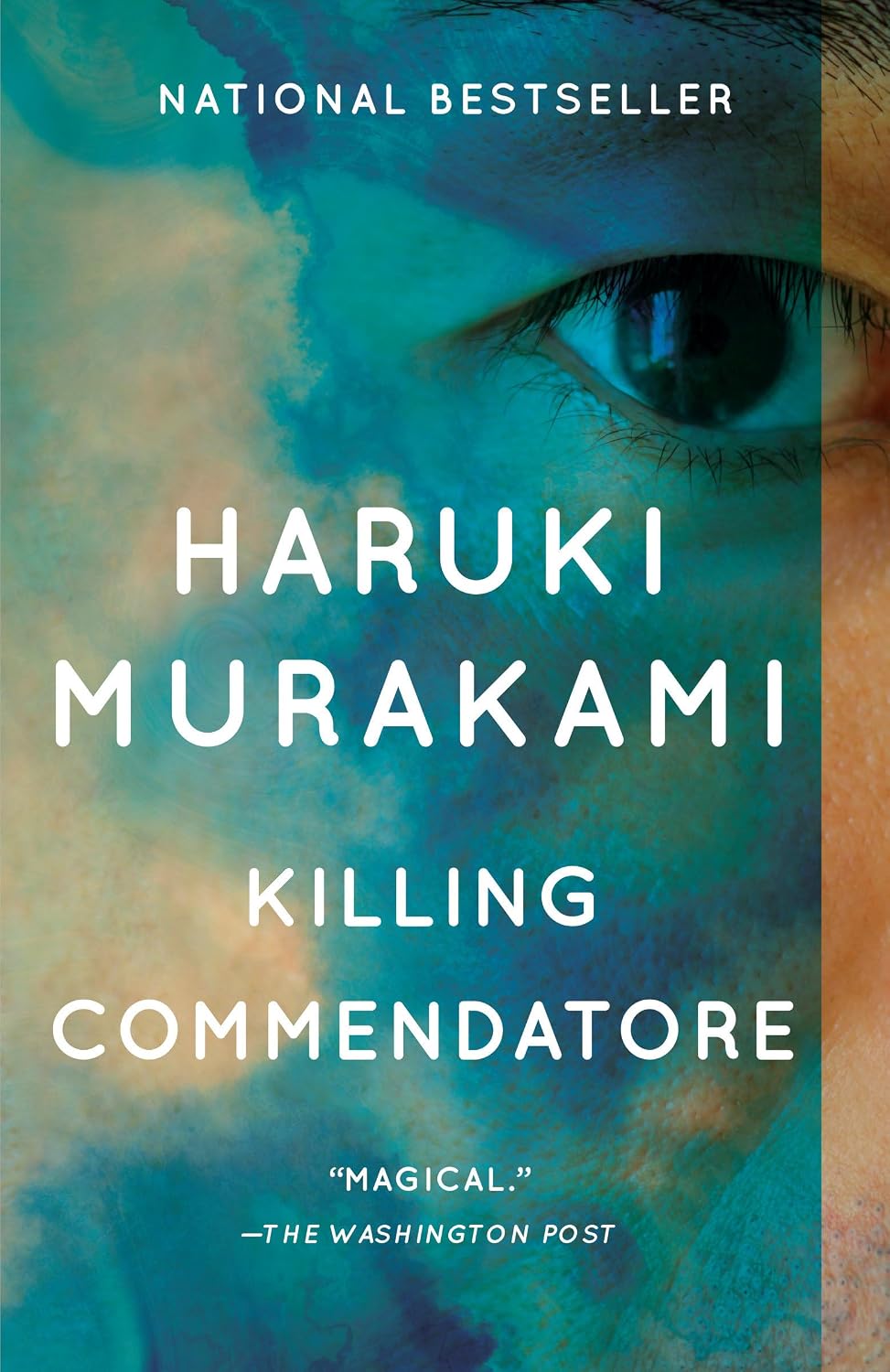
As close as Killing Commendatore comes to relitigating the generational conflict of Floating World, Murakami sidesteps the question by acquitting his war-era artist of Ono-esque wrongdoing. Tomohiko Amada is this book’s Ono generationally speaking, but he takes the principled political stand that Ono can’t muster. From 1939 to 1947, we are told, Amada “stayed as far removed as possible from what we might call ‘artistic circles.’ He couldn’t stand that crowd anyway, and their ‘nationalist art’ glorifying the war effort made him like them even less.” Far from grappling with whether those nationalist artists should have killed themselves after the war, Murakami portrays a different sort of principled suicide. Amada’s brother slits his wrists to evade culpability when ordered to execute Chinese prisoners.
My cynical side wonders (get ready for a digression of Murakamian proportions) if Murakami made a hero of his Ono just to avoid implicating himself in a generational conflict of his own. Murakami’s literary star has been rising in America in recent years, but enthusiasm for his originality and captivating storytelling are increasingly tempered by post-Gen X objections to his constant indulgence in graphic het male sex and gender Othering. These objections have been standard for 30 years, yet Murakami STILL draws ire from younger readers for his sexual preoccupations.
In 2018’s Killing Commendatore, Murakami makes 13-year-old Miyake’s dissatisfaction with her breast size a jaw-droppingly oft-invoked running gag. For once, Murakami’s adult protagonist does not openly flirt with his tween admirer, but he does offer helpful insights about the size of his penis. Female Gen Z’ers like Fable’s Lys seldom review Murakami without expressing disgust with this aspect of his oeuvre. Lys “really enjoyed” Killing Commendatore but withholds a positive rating because of the Miyake boob gags: “I mean, to be expected really but come on man how many times do we have to tell you to STOP.” If Murakami has heard these cease-and-desist orders, he isn’t letting on. In Novelist as a Vocation, his 2021 writer’s guide, Murakami offers this stunningly oblivious anecdote:
Once when I was talking with a young woman reader, she asked me, “Mr. Murakami, how is it that though you’re a man in your sixties, you understand young women’s feelings so well?” (Naturally, there are lots of people who don’t share this opinion; I’m just giving this as the opinion one reader had.) Haruki Murakami, Novelist as a Vocation
As a man in my fifties, I have never shared Murakami’s apparent perception that women like Miyake and 1Q84’s Aomame spend copious time on bosom-based ennui. Perhaps he is too impressed by what surely must be outlier comments like the one he cites to worry about the disgust he invokes in young Americans. Still, I can’t help wondering: Does Murakami intuit that any attempt to censure his parents’ generation for their war-era shortcomings would result in generational censure of his aging-hippie Free Love value system?
Whatever the reason, Murakami, like Ishiguro, uses postwar trauma as a backdrop for an entirely different thematic exploration. His has nothing to do with guilty narrators. Rather than tell the story from Amada’s wartime perspective or his own generation’s postwar vantage, Murakami entrusts the book to another earnest young Murakami Man. Not familiar with that alliterative designation? Google it and you’ll find countless references without attribution to its originator. Nearly every Murakami novel is narrated by a generic tricenarian, modest, often divorced, LP-collecting, pasta-and-sushi-cooking male.
This one, a talented portrait artist curious about dabbling with other forms, doubts his own reliability at the outset: “`Something’s wrong with me,’ I thought as I stared at myself in the mirror. … Better not get near anyone.” This feeling is driven by guilt and grief over a surprising marital breakup and a sexual encounter that got uncomfortably rough. But after each of the book’s three supporting M’s—Miyake, neighbor Menshiki, and friend Masahiko—endows him with unwavering trust, this Murakami Man comes to see himself as a normal guy haunted by normal angry feelings.
Because the setup feels real, and because most men bear a capacity for latent violence, the trust does not feel cheap, and the hero even begins to seem less generic than most of his predecessors. But if Ishiguro explores World War II reverberations in order to explore narratorial unreliability, Murakami’s choice of a reliably reliable narrator is a hard pass at repeating Ishiguro’s approach. Murakami is signaling that his core inquiry lies elsewhere.
Murakami’s Message:
The Idea Made Visible

The core idea of Killing Commendatore is that, rather than forming an Idea for a work of art and then meticulously perfecting it, the artist often begins creation in search of an Idea. In the novel, Murakami Man starts a portrait of Menshiki without knowing what he is trying to capture:
My sketches had accurately captured what was distinctive about his face, yet there was nothing about them beyond the sense that they were well-done drawings. They were all oddly shallow and superficial, devoid of depth. They were no different from caricatures drawn by some street artist. Haruki Murakami’s Killing Commendatore
Over time, the portraitist finds something in Menshiki that is worth painting. For Murakami, this usually means finding a metaphor. For instance, Amada’s finest work converts a scene from the Mozart opera Don Giovanni into scene from a forgotten period of Japanese history. This brings his Idea, the Mozartean creation Commendatore, to life in Amada’s house, just as he came to life from a statue in Mozart’s opera. This is a fascinating meta representation of the Murakami vision of the artist’s journey.
I have long felt that Murakami’s work fossilizes his own early probing for a point. This doesn’t always work. In 1Q84, he found an interesting central juxtaposition (religious fundamentalism and domestic abuse) that served as an Idea, but he never but never settled on a metaphor that would give purpose to its dramatization. Instead, he blew up the novel’s dark side with a horrifically exculpatory plot twist (the rapist isn’t really a rapist; he’s forced to rape by jolly dwarves). But sometimes Murakami finds the perfect analogy. John Updike’s New Yorker review of Murakami’s high-water mark, Kafka on the Shore, explained how the author’s quest for meaning through metaphor in that novel thrillingly illuminated postwar reckoning:
This novel quotes Goethe as decreeing, “Everything’s a metaphor.” But a Western reader expects the metaphors, or symbolic realities, to be … organized by certain polarities, in a magnetic field shaped by a central supernatural authority. No such authority controls the spooky carnival of “Kafka on the Shore.” To quote Colonel Sanders once more: “Listen—God only exists in people’s minds. Especially in Japan, God’s always been kind of a flexible concept. Look at what happened after the war. Douglas MacArthur ordered the divine emperor to quit being God, and he did, making a speech saying he was just an ordinary person.” John Updike, “Subconscious Tunnels,” The New Yorker
In Killing Commendatore, Murakami’s central metaphor is equally illuminating: Commendatore’s transubstantiation symbolizes art’s power to create a tactile link between artist and subject. The metaphor is fragile, but it works best when Murakami goes all in, as in a climactic hero’s journey through a perilous underworld with its own River Styx that one character, a renegade figure incarnated from canvas, declares “is a metaphorical river, but the water is very real.”
Ishiguro on Murakami’s Terms:
Competing Metaphors

Ishiguro’s fiction doesn’t swing through such polarities. He once told an interviewer that he “tries to avoid anything that is overtly melodramatic or plotty, that tries basically to remain within the realms of everyday experience.” Such a grounded methodology means whittling his central conceit into 206 tightly coiled pages, not expanding it, like Commendatore, into 733 pages of sloppy intellectual thrill-ride.
Interestingly, though, Ishiguro, too, explores in his writing rather than writing a preformulated outline. He begins with a story, an Idea, and starts writing in search of a setting. He knows the events, but he is like a film director scouting for a time period and locale.
“You can think of me like an early aviator before airplanes were properly invented. I’m building some sort of flying machine in my back garden. I just need it to fly. And you know how odd some of those early flying machines looked? Well my novels are a bit like that. I put them together out of anything I can think of according to my thinking to make the thing fly.” Kazuo Ishiguro, “I’ll Take as Long as I Need,” The Talks
Their methods may be similar, but their mediums are a world apart. An Artist of the Floating World is the meticulous historical analysis of a writer doubling as both prosecuting attorney and absolving confessor. Killing Commendatore is a gloppy lasagna piled high by an Iron Chef. In other words, it is a daredevil reach for greatness at tremendous risk of failure. Playwright Tony Kushner explains why lasagna is the perfect metaphor for ambitious writing in a classic essay:
Baking lasagna has long been my own personal paradigm for writing a play. A good play I think should always feel as though it’s only barely been rescued from the brink of chaos, as though all the yummy nutritious ingredients you’ve thrown into it have almost-but-not-quite succeeded in overwhelming the design. A good play should have barely been rescued from the mess it might just as easily have been; just as each slice of lasagna should stand tall, while at the same time betray its entropic desire toward collapse, just as the lasagna should seem to want to dissolve into the eat and cheese stew, so you can marvel all the more a the culinary engineering magic that holds such entropy at bay, that keeps the unstackable firmly, but not too firmly, stacked. A good play, like a good lasagna should be overstuffed: It has a pomposity, and an overreach…. It is pretentious food. Tony Kushner, “On Pretentiousness”
At the risk of presenting one metaphor too many, it’s worth noting in conclusion that both writers were musical professionals before they started writing novels. Ishiguro was a singer/songwriter in the tradition of Bob Dylan and Leonard Cohen, and he is still carefully compressing his themes into tight three-minute lyrical structures. Murakami was a jazz club owner, and he is still giving his characters a place to improvise wild discursive solos.
For both Ishiguro and Murakami, a writer does not need to construct a seven-mast schooner before dipping a toe in the river of metaphor. Once adrift on the consequential reality of its waves, these authors are capable of assembling the boat midstream, billowing sail by billowing sail.
Postscript
I have written an addendum to this essay called Stacking “Killing Commendatore” Against An “Artist of the Floating World”. It tackles probing questions such as:
Which of the two books is the superior work of literature?
Is Killing Commendatore just a shameful retread of The Wind-up Bird Chronicle?
Is An Artist of the Floating World just a shameless retread of A Pale View of Hills?
Why are both authors often criticized for their flat prose?
And does translator Dwight Egan Sora consider flat prose a Japanese cultural characteristic?
Also, please note that Sadie Seroxcat, editor of Medium’s Counter Arts publication, generously selected this essay for publication in its Literature section starting Thursday August 13, 2026. She has my thanks.
An Artist of the Floating World was shortlisted for the Man Booker Prize in 1986."