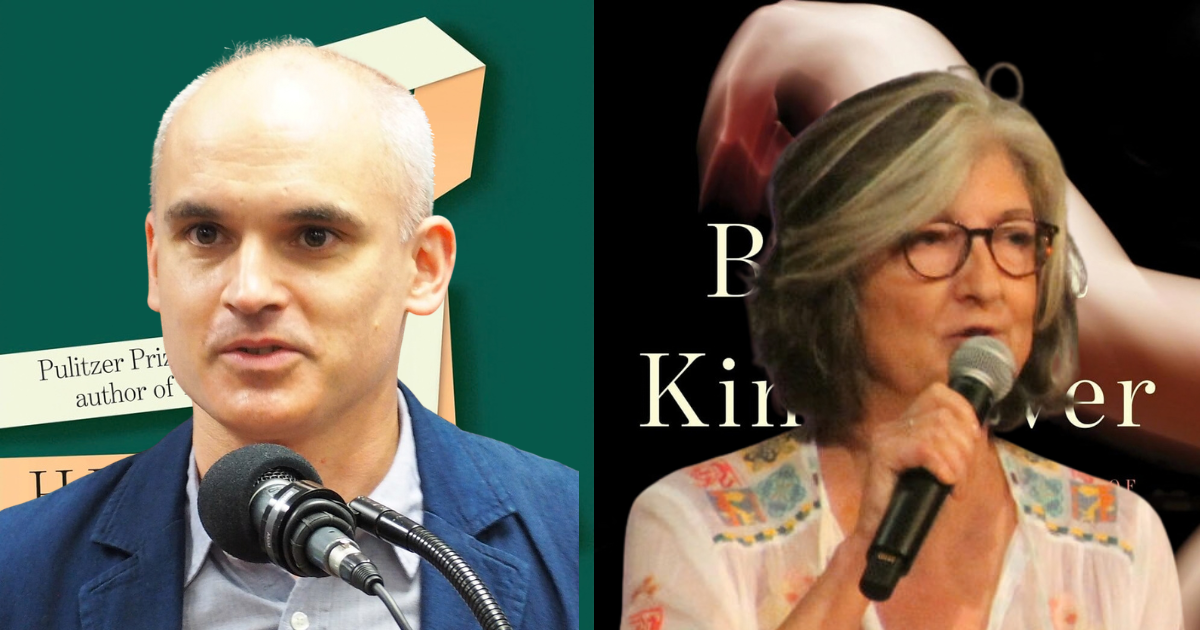
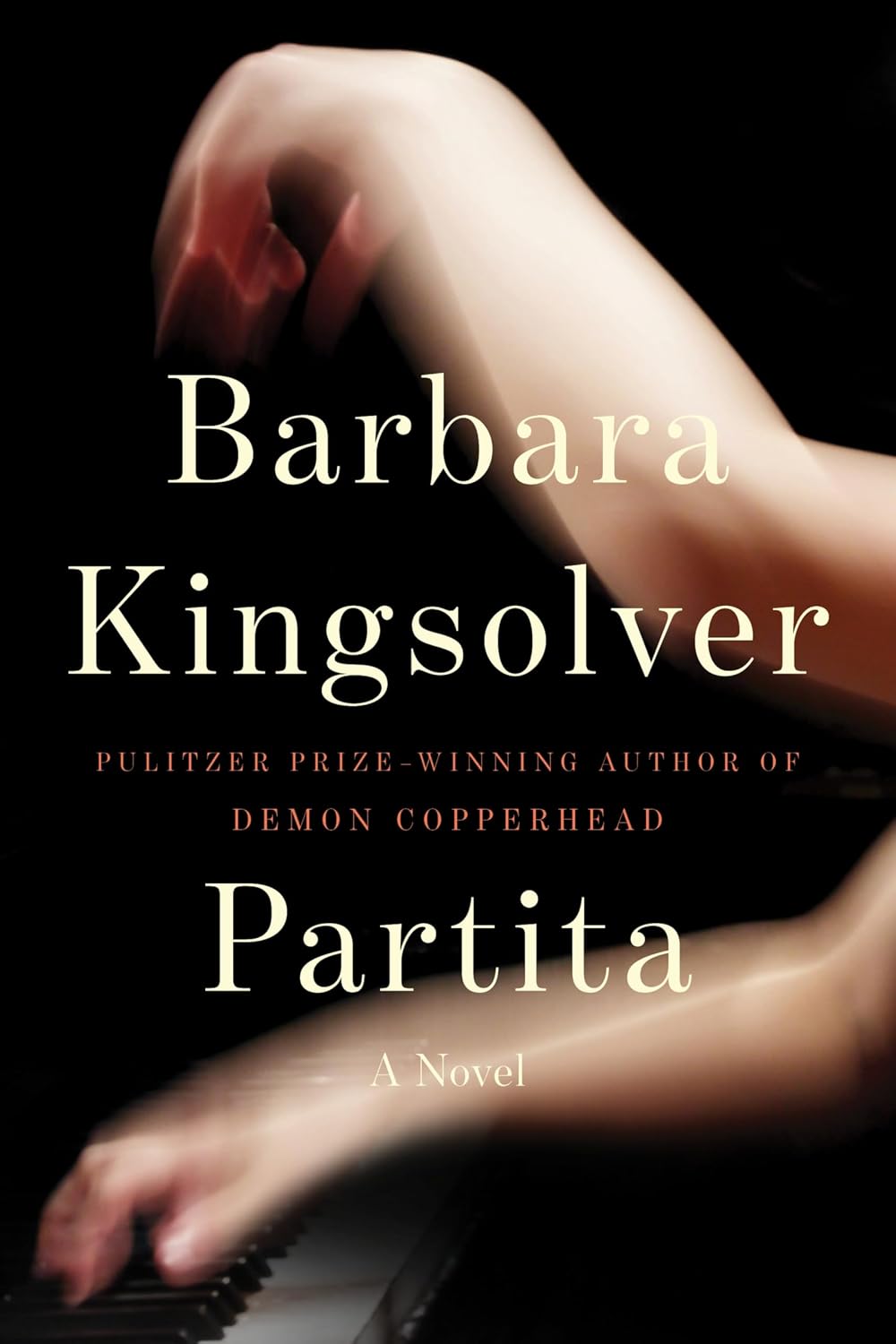
In her new novel Partita, Barbara Kingsolver shuttles her narrative back and forth across the insuperable chasm of lost identity. On an Indiana campus in 1989, Livvie Bohusz is a disciplined student pianist on the cusp of classical stardom. On an Indiana farm decades later, Livvie Cable is a disillusioned farmer’s wife who can’t see an upright piano without enduring convulsions of regret over the career that never materialized. “I’d been mad about all of it for so long, I might have lost sight of the parts I had left,” Livvie tells us.
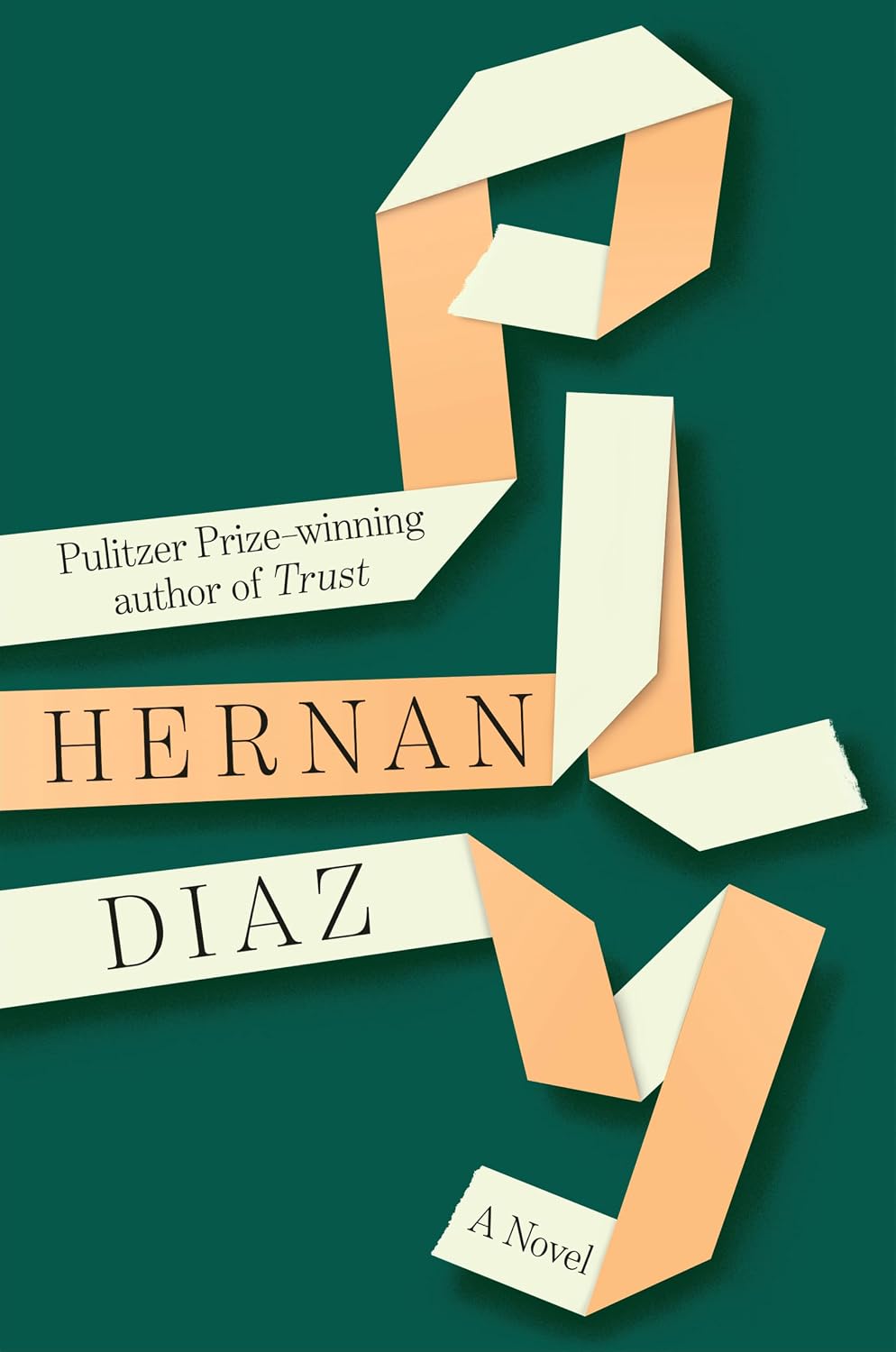
In Hernan Diaz’s Ply, the plummet is just as steep, but intrepid wayfarers contemplate a crossing. Centuries into the future, the state has crumbled, leaving only outsourced enforcers of corporate greed. Science has disassembled the self into clumsily bundled particles, but good riddance to bad rubbish. It’s the end of the world as we know it, and I feel fine. “Isn’t it endlessly more interesting,” asks a scientist, “to think about the wonderful combinatorial madness that makes us up rather than to lazily picture ourselves as static magical creatures?”
When last we met Kingsolver and Diaz, they were the only novelists to tie for top honors in a century of Pulitzer Prizes. Their follow-ups, both coincidentally released this week, depict the painful reconstruction of a sense of self that never fully came to be, but one explores that topic with painstaking authenticity of setting while the other seldom resists the temptation to refract the theme through yet another prismatic theoretical variation. In the end, both strikingly affirm community as the mystical core of the self itself.
Pulitzer Rematch
Exit poll data from the 2023 fiction voting are unavailable, but one suspects that Trust and Demon Copperhead split adjudicators straight down the Thinking/Feeling axis of the Myers-Briggs Type Indicator. Diaz’s four-chambered architecture was intellectually impressive, a quartet of books-within-books reporting the same narrative of Depression-defying fiduciary acumen. Kingsolver’s Demon, which thrifted its story wholesale from David Copperfield by Charles Dickens, couldn’t parry Trust’s structural ingenuity. But its self-medicating orphan’s tortured charm charged full bore at the reader’s empathetic heart.
This time out, both writers are firing on all emotional cylinders. Kingsolver had me suppressing sobs at the impossible distance between Icarus-eyed youthful expectations and the grounded satisfactions of adult reality. Meanwhile, Diaz cribbed emotional impact from Kingsolver by cribbing from Dickens. His tenacious orphan is a descendant of Copperfield or Oliver Twist. She has lost her mother, girlfriend, roommate, childhood idol, and philosophical father figure. Instead of picking a pocket or two, however, Diaz’s protagonist avenges herself by shutting down the power matrix in the fossilized remains of New York City.
As affecting as both stories often are, they also provide substantive nourishment for the intellect. Both feature postmortem analyses of fledgling Marxist revolutions that never arrived. And both break down the wordless transcendence of incidental music that satiates head and heart alike. Kingsolver provides a classical playlist that readers can plug into Spotify while Diaz invents his own futuristic DIY genre.
If Kingsolver and Diaz do find themselves pitted against each other again next spring in a Pulitzer rematch, the results may hinge on a different dimension of the Myers-Briggs taxonomy. Partita has a real-world specificity that will appeal most to Sensing decision makers, while Ply’s relentless demands on the reader’s facility with abstract connections are likely to be most persuasive with Intuitive types.
The Cherished Past
I was always decked out for recitals just decently enough, starting with little-girl church dresses with sashes that tied in back. My look didn’t change all that much as my performance arena expanded into regional competitions with sophisticated peers. … Once, I overheard a tall, acne-pocked boy from Chattanooga refer to me as “the Amish chick,” before he swaggered onstage and botched his Rachmaninoff. Just wait until you hear me was what I always thought, trusting the rush of competence to flood into my hands along with the passions that blazed through my body, vibrating out through the piano strings, pinning my listeners to the backs of their seats. That’s how I pictured it, without looking up from the keys until it was over. But then I would see those faces. I have a satisfying memory of the pimple-faced Chattanooga boy, open-mouthed. Later that day, he asked me for my phone number, to what end, I couldn’t guess and didn’t oblige. Livvie Bohusz in Barbara Kingsolver’s Partita
Kingsolver’s exacting depiction of big-fish mastery in the small pond of late 1980s Indiana exhibits the same earned cockiness it describes. For me, it brought back vivid memories from my own days as a competitive high school performer in a neighboring state during roughly the same period. I had no skills as useful or bankable as Livvie’s, but between my junior and senior years something clicked into place in the obscure subgenre that “humorous interpretation” occupies within the obscure subgenre of high school speech team.
“Dockers are the poor man’s denim,” one competitor whispered audibly to her sniggering classmates as I approached the front of a repurposed Algebra classroom clad in loose-fitting navy Dockers and a frumpy paisley sweater. The gales of friendly laughter that erupted throughout the room at my rubber-faced portrayals of six distinct comic characters soon put the sniggerers in their place and sent me home with a chintzy first-place trophy. My facility with cartoon characterizations was laying a groundwork of bad habits for acting pursuits later in life, but for two years the theater kids learned to lay off the Dockers jokes.
By chapter five, Livvie is parlaying keyboard dominance into climactic college practice room sessions with Sigurd, a charismatic socialist whom she tutors in female anatomy and Maurice Ravel’s “Ondine.” They fall hard for one another, but she can’t tell whether his wrenching decision to prospect the western states for revolution is motivated by political idealism or a protective impulse to get out of the way of her star trajectory. Either way, Kingsolver conjures a Bloomington of 1989 (“a year of earthquakes and oil spills and iron curtains starting to crash”) distinctly more receptive to Sigurd’s ideology than the Trumpy rurality she has settled for when they reunite in middle age. “They think ‘socialism’ is some fantasy game cooked up by college kids,” an aging Sigurd confesses to Livvie. “Subsidized health care and food stamps sound like handouts, which are the opposite of respect for labor.” Sigurd too has a lost self to grieve.
If Partita locates the cherished past in the youthful dreams of its characters, Ply erects a dystopian ethos in which not only authoritarian iron curtains but also democratic ideals have long since crashed into oblivion. Here, the lamented lost identity belongs to humanity itself.
Toward the end of the modern era, a big shift started. All the institutions associated with the Renaissance, beginning with the democratic states and their laws and their currencies, faltered. Where there used to be social mobility, an unbending caste system solidified. What had meant so much for so long, those inalienable rights and legitimate aspirations, became meaningless over the course of a mere couple of centuries. And even the concept of the human itself lost its central position. Our devices redefined what both ‘intellect’ and ‘consciousness’ meant; the very notion of experience, which is how we meet reality, was challenged; people’s lives, once precious, became cheap as the legal scaffolding that provided equal shelter to each person was dismantled. To understand the magnitude of this historical process, you need to compare the end of the Renaissance to the end of the Middle Ages: The exile of God that began in the fourteenth century was just as momentous as the expulsion of the human that began in the late-modern times. We’ve yet to see what comes next. Acevedo in Hernan Diaz’s Ply
I found Ply most counterintuitively compelling in passages like this, where Diaz allows himself to sink his teeth into unapologetically meaty abstractions. The plot, about the orphaned “pincher” committed to the equitable redistribution of energy, is not without poignance or suspense, but it is puzzlingly thin. Diaz’s heroine is nameless, alternates oddly between first- and third-person narration, and is surprisingly devoid of gender specificity. If Diaz identifies her sex in the first few chapters, I missed it, and he provides nearly as much romantic intrigue around the pincher’s male mentor Nelson as her female lover Sol. Not that there isn’t something courageous about the impulse to ghost nosy reader inquiries into the ultimately meaningless cultural inheritance that we call gender. But that generic sexlessness points to a broader lack of peculiarity in Diaz’s heroine. He could have control-H’d the feminine pronouns into masculine ones, and the novel wouldn’t have budged an inch.
Diaz seems more energized by exposition of his dystopian premise, where the rebuilding-from-scratch ethos of his “Suppression” is more than a little reminiscent of Ian McEwan’s low-tech “Derangement” in the 2025 novel What We Can Know. “Struggling to go back in time wasn’t just reactionary; it was insane,” Diaz’s narrator asserts. “Inaugurating a president would be as absurd as crowning a pharaoh or appointing a caesar.” The state is dead. Long live the anti-state.
The Lost Self
The burdens carried into adulthood by Diaz’s pincher and Kingsolver’s pianist are mostly driven by tragic mishap, but both novels also turn on the mental distortions of their characters. On the now side of the chasm of identity, an emotionally and physically wounded Livvie has just buried her mother, an abusive hoarder who left behind an imposing King Tut’s tomb of glutted cardboard. Livvie is learning to translate a lifetime of disgust with maternal packrattiness into the clinically permissive language of Obsessive Compulsive Disorder. “We all accumulate,” she allows. “Not junk but feelings.” Livvie’s hoard of choice is PTSD stemming from a brother’s childhood suicide that is revealed in the early pages of the novel.
Once again, a precise trait that Kingsolver invests in individuals is abstracted by Diaz to the whole dystopian populace: “Everyone in this city is a bit of a hoarder. Impossible to know what will be needed in the future. … People find it hard not to cling to random objects, often for a lifetime, regarding them alternately as garbage or treasure.”
Individual Ply characters struggle with cognitive symptoms as well. The most vivid brush with insanity across both books belongs to Pola, the aging, is-she-mad scientist who brings flesh-and-blood believability to the second half of Ply. “Isn’t it clear why absolutely everyone in the scientific community deemed my invention absurd?” she asks rhetorically about her outlandish application of quantum physics. “This is why they all believed I had lost my mind.”
The pincher lacks the math skills to answer Pola’s query, which means their partnership comes at harrowing personal risk. If Pola is crazy, the pincher is toast. But she can’t even trust her own mind. As early as the first chapter, the pincher confides, “True paranoia comes about when one’s own paranoia becomes the object of one’s own paranoia.”
The tendency of the pincher’s mind to betray her own best interests unlocks a chilly memory. The “rush of confidence” I felt in some invitational final rounds gave way to black tufts of dread in the culminating moments of my high school speech team career. I was one of only two representatives of my team left standing at the state tournament. An unusually lengthy wait for the results of preliminary rounds in my category became an increasingly burdensome weight on my state of mind. God showed up in my thoughts to find me wanting of sufficient humility. I care too much. I care too much.
I staggered to my final round with unresolved holy bargains crowding out internal preparation. The resulting fifth-place finish might have been a source of pride if I’d performed with characteristic energy. The following week, at a meaningless postseason invitational, a judge who had been assigned to my state final round told me, “You were much better today.” I grunted polite dissatisfaction, and she looked appropriately affronted. “That was intended to make you feel good,” she said. The strange thing was that even in my season’s final session with my ebulliently committed coach, I still felt like I wasn’t supposed to care about success. When I told her so, my coach’s jaw drop was almost hostile. “You didn’t care?” That woke me up. Somehow I’d forgotten how much she did.
“You want too much when you’re young,” writes Livvie with melancholy hindsight. “It’s just what you do. What we did. Made a fire with so much fuel, it had to burn itself out.”
Having plundered world-spanning historical, philosophical, economic, and political abstractions in Part 1 of Ply, Diaz expands his ambitions into the universe’s largest and smallest spaces in Part 2. I was tempted to regard that ambition as hubristic overreach. But as long ago as 1927, E.M. Forster was already cautiously praising Herman Melville’s prophetic incorporation of big ideas into Moby-Dick and Billy Budd. “What one notices in [Melville] is that his apprehensions are free from personal worry, so that we become bigger not smaller after sharing them.” By reaching into the universe’s secrets, Diaz hopes to transcend his characters’ petty anxieties.
Pola has constructed a particle accelerator capable of unlocking quantum entanglements and Einsteinian secrets of space-time despite the risk that it generates a black hole. It is only on these infinite and infinitesimal scales that we gain some sense of what is to follow “the expulsion of the human.”
For thousands of years, people have believed selfhood to be some sort of vaporous essence. … But if you accept, as you must, that we are a collection of cells, made up of molecules, made up of atoms, made up of elementary particles that are ruled by clearly defined physical laws, you must conclude that what we experience as ‘I’ has to be the result of the interaction of matter at this fundamental level. You, I, we emerge from this interaction. We are this interaction. There isn’t, so to speak, a “will” behind it that “holds” or “moves” it. We are nothing but a constant becoming that results from the ceaseless interplay of particles and forces. Pola in Hernan Diaz’s Ply
If the motion of two distant particles can become “entangled” with one another, Pola suggests, perhaps people, too, are interconnected in ways beyond our imaginings.
Amazing Grace
Those sacred interpersonal entanglements soothe the fraught reunion with Sigurd that has loomed over Livvie’s comfortable marital partnership since the opening pages of the book. When Livvie treats Sigurd to a community recital of her country piano students, the consequent celebration of slow and steady adulthood over childhood dreams grows slightly sloppy in its Capraesque Bedford Falls benediction. But as a middle-aged reader who once occupied a self that found himself wishing there was a speech team pro league (or at least a speech team farm system? I would have settled for community speech team pickup games), I am squarely within Kingsolver’s target demographic. For me, it was hard to resist the healing energy she pinches off the entangled grownup power grid.
Diaz’s exploration of human priorities fading from human society has a lot of big ideas straining for limited air in his dystopian atmosphere. But as perfunctory as the pincher is as a central character, Diaz does build a trinity of friends that wins points for Gryffindor: the Potter-like pincher, the know-it-all Pola, and a street-smart homeless child who is admittedly more Artful Dodger than Ron Weasley. They never fully trust each other, but they learn to soothe one another’s frayed nerves, and their defiant collective spirit is the best hope of the resistance. Theirs is the entangled new identity that supersedes the lost “I” of individualism. “You, I, we emerge from this interaction,” Pola says, apparently referencing the emergent team. “We are this interaction.”
“What I care for, what moves me, is someone touching the edges of the utterable and trying to push through them. Someone saying what their language won’t allow them to express. Didn’t you tell me that this can happen in science? Didn’t you say that science is the refusal to remain silent about what can’t be said? In music, whether that impossibility or those constraints result from a lack of education or an excess of formal awareness doesn’t matter to me. I’m interested in hearing someone, against every obstacle, trying to emerge.” The pincher in Hernan Diaz’s Ply
That speech, a declaration of concomitant adoration for three-chords-and-the-truth punk aesthetics and the formal perfection of Bach and Chopin, could have been lifted from the pen of Barbara Kingsolver, but it was written by Diaz. In one fell swoop it eulogizes Livvie’s virtuosity and foreshadows the striving humanity of Diaz’s post-human adventure.