
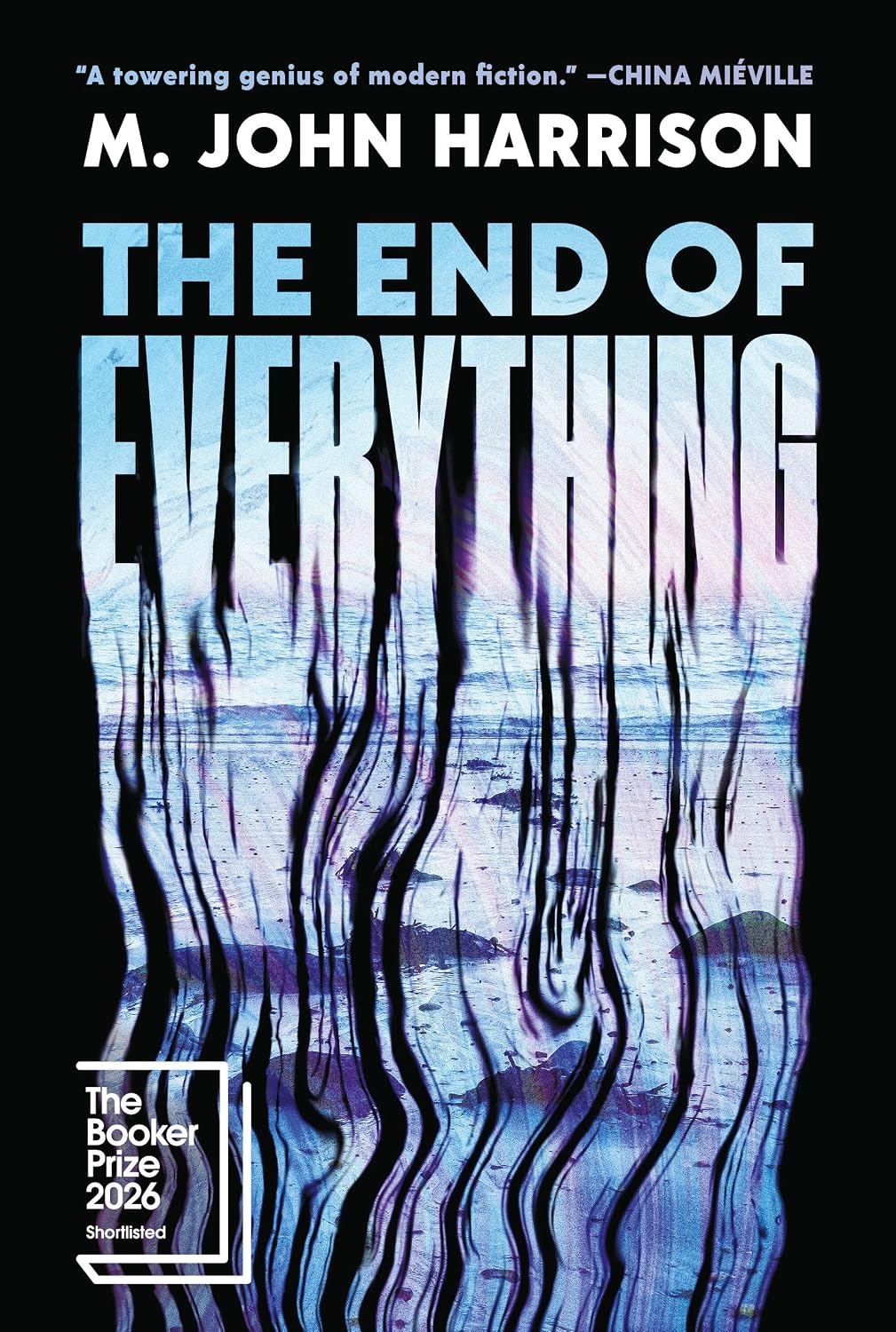
My vote for last place among the six shortlisted novels is M. John Harrison’s The End of Everything. I felt pretty strongly about this one. So did the jury; they gave M. John Harrison the Booker Prize for his challenging novel. I recognized of course that some readers enjoy it, but in this company it seemed slight (206 pages), controversial (at 2.86 as of this writing, it has the lowest Goodreads score even of the longlist), and far more likely to be described as experimental than successful.
Yeah, well, shows what I know. Congratulations, M. John! You show ’em!
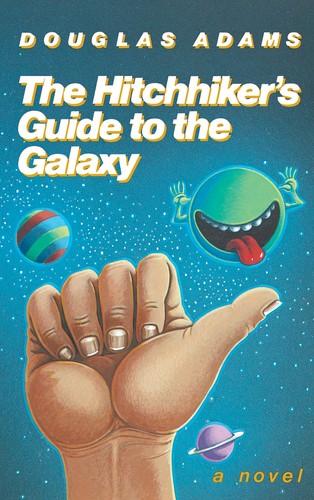
Just for fun, I compared each Booker novel, at least in passing, to a classic work of literature with which it has something in common. Today’s “classic” may not meet every use of that word, but it unmistakably lives up to Merriam-Webster’s top definition: “Serving as a standard of excellence: of recognized value.” The book is Douglas Adams’s 1979 comic sci-fi masterpiece, The Hitchhiker’s Guide to the Galaxy.
Ankle-biting Science Fiction
The End of Everything is a tantalizingly decisive title for the determinedly ambiguous science fiction story M. John Harrison has laced fragmentarily throughout his Booker shortlisted novel. The catastrophic certainty the title promises is enough to inspire a certain degree of diligence in reading this intriguingly weird version of the apocalypse. But I had trouble staying engaged long enough even to notice the widely scattered landmines of narrative advancement Harrison has planted in the soil of his otherwise utterly mundane dystopian future. When detonated, these landmines do not rattle our foundations or jolt our nodding attention spans. They do not boom; they pfffff unnoticeably in the sand as we pass: “Oh wait, I think something odd just happened in the middle of that stultifying diatribe about beachcombing.” The explosion sprays just enough dirt around our ankles that we have a fighting chance of noticing it when we’re meticulously scanning for ticks.
Many readers may find The End of Everything forbiddingly odd. My objection is the reverse. I enjoyed Harrison’s indulgent weirdness at times, but he seems agonizingly shy about letting his freak flag fly. For most of the novel, he buries that flag under sedative poppy fields from Oz. If peculiarity is the superpower of The End of Everything, why must we plow thickets of brambly respectability just to catch an ephemeral glint of eccentricity?
A Plot That Defies Description
I’m not sure I was vigilant enough in Harrison’s weeds to provide a reliable plot description, but here is my best effort at such.
In a year terrifyingly imprecise in its relation to our own, accumulating paragraphs of evocatively atmospheric expository descriptions are painstakingly specific about all the wrong things. The coast of Kent, or the vast surface of Planet Earth, we’re not entirely certain which, have recently endured a disaster so traumatizing to our daily functioning that everything seems more or less unaltered. The catalysts for this take-my-word-for-it catastrophe are alien invaders unexplainedly called the iGhetti, a bewilderingly unetymological designation that conjures nothing so much as Apple-designed electronic devices marketed to inner city residents.
Oh, and the aliens probably aren’t aliens. They are more likely shapeshifting visitors from the astral plane. It is unclear why they have shapes to shift then, given that the astral plane is usually defined as the realm of the intangible. But basically the creatures are babies one day and adults the next, and they are both companionable road buddies and also slapdashedly gleeful at the prospect that we will eat the dead bodies of our most cherished relatives.
Earth’s remaining populace, which has dwindled from the unspecified economic impacts of a war that wasn’t a war, fear the iGhetti so intensely that we comb the beaches looking for them in the hope of selling them to one another on the open market. “The world’s over,” declares Phillip Tennent, our protagonist until he isn’t, with lackadaisically supported menace. “But that doesn’t matter. Because another one will be along soon enough.” Let me guess. When the bold new world arrives, it will be generally indistinguishable from both ours and his.
Priorities, M. John
Perhaps you are wondering what, in all this opacity, Harrison deems worthy of “painstaking” detail, and I am happy to oblige. The first half of the book, “PART ONE: War in Heaven” (another title that promises undelivered drama), contains four consecutive chapters titled “The sign.” The first “The sign” begins as follows:
On all those reliable maps of the pre-disaster period, the town assembles itself as a rough triangle, the base of which is a strip of the old coast road running along the seafront for half a mile between a roundabout in the south and a golf course in the north. From this foundation, the sides of the triangle waver up inland, rising gently until the apex penetrates the chalk to admit a river, a railway line and an elegant military canal from the Martello period. M. John Harrison, The End of Everything
I hope that’s enough to get across Harrison’s narrative priorities, though he continues this tangent for the duration of the chapter. His omniscient narrator drones on blandly about inns, manses, customs sheds, fish and chips bars, antique shops, piers, arcades, cakes, and ices, while apparently utterly lacking the strength to force the moment to its crisis.
The only words in the entire chapter that struck me as even vaguely connected to the dystopian premise upon which the novel’s entire claim to Booker distinction rests are “pre-disaster period.” But those words appear only once, hovering in fruitless isolation atop the chapter’s soon-forgotten opening sentence. I have no interest in going antiquing with you, M. John, no matter how quaint the surroundings. Elaborate on that disaster.
Psyche!
That’s not to say that there aren’t passages that eschew these pedestrian descriptions and focus undistractedly on the development of the book’s promisingly weird ethos. But even then, every potential foundation the author provides for the reader to stake a pioneering flag of interest is immediately stripped away. “In the beginning — if there could be said to have been a beginning — no one really understood what had happened.” Okay, but they do now, right? “Social media was as useless as ever, and though the war with the iGhetti continued, people could never agree what kind of a war it was, or what its boundaries were.” And that’s it. Expository passage over, and off we go into obstinately uninformative description: “two pubs, a terrace of flint-faced almshouses and a Queen Anne vicarage, organised around a small but somehow spacious square … " What are you even talking about? Was there a war or not?
Playing for Laughs
I am not indifferent to the possibility that the juxtaposition of the author’s maddening inattention to the novel’s actual plot with his tireless captivation by the pedestrian specifics of present-day suburban England might be intended as some form of comedy. The Booker Prize website describes The End of Everything as “slyly satirical.”
I flatter myself that I am something approaching an ideal audience for that kind of bone-dry straight facedness. In my college improv days, my teammates were unable to persuade me that gesturing toward a line of empty stools and saying, “Ladies and gentlemen, the Dancing Chairs!” did not constitute the apex of American comedy.
But if Harrison is concealing a giggle at his resolute defiance of traditional narrative, I wish he’d find some way to let us in on the gag. “Something happened, no it didn’t, yes it did” might make me laugh if it wasn’t wedged into pages of agonizing boredom.
What’s more, I recognize that, comedy or not, the book’s evasiveness is intentional. Harrison is reaching for a thematic statement, which the Booker website underscores when it describes the novel as “shimmering and oblique.” The trouble, for me specifically, is that his execution of that idea is so off-putting that I don’t actually care what point he is trying to make by writing badly.
Living Up to the Classics
To his credit, Harrison does allow the narrative in its second half to indulge incrementally more lyrical doses of dryly comic strangeness. In one climactic sequence, a grieving woman is presented by the iGhetti with a grotesque recreation of her recently departed loved one, as though it were an adequate substitute for lost humanity.
By now she could be sure it was, if not Philip, then a version of him, a bad guess, an attempt tailored to her needs, her own sentimentalised memory.
‘You couldn’t ever be him!’ she said. All this was something being forced on her, she felt, rather than just the pantomime of entities that had no idea how to be human. The room was suddenly full of projections. It was full of counter-transference.
‘I can have another name if you like,’ the driver offered.
‘He can have another name,’ the girl repeated, carefully closing the door of the armoire. ‘Just for you!’
‘He’s not a he. He’s an it and so are you.’ M. John Harrison, The End of Everything
It is a striking passage. Here the poppies recede and Harrison waves in the direction of salient insight. The scene ends in a violent outburst that is pleasingly sudden and exquisitely timed. But Harrison still refuses to ground the scene in enough imagined specificity to make its abstractions decipherable. The nature of the recreated loved one, the nature of its creators, their purpose in creating it in the first place, all remain steadfastly opaque. Even when the freak is on full display, Harrison shies from full commitment.
Did anyone ever tell Harrison that humor resides in specificity? The driver scene reminds me of a similar episode in a book that remains my gold standard of wry apocalyptic fiction, The Hitchhiker’s Guide to the Galaxy by Douglas Adams. Granted, Harrison and Adams are not striving for comparable effects. But Adams too wrote a scene in which bewilderingly alien aliens unconvincingly offered a replacement for a human’s irreplaceable humanity, and I recall it vividly to this day even though I last read the book as a tween.
The premise of the scene is that Benjy and Frankie, a pair of superintelligent aliens in the bodies of white mice, offer to buy Earthling Arthur Dent’s brain for research purposes. Zaphod Beeblebrox is Arthur’s multiheaded frenemy.
“It could always be replaced,” said Benjy reasonably, “if you think it’s important."
“Yes, an electronic brain,” said Frankie, “a simple one would suffice."
“A simple one!” wailed Arthur.
“Yeah,” said Zaphod with a sudden evil grin, “you’d just have to program it to say What? and I don’t understand and Where’s the tea? Who’d know the difference?” …
“I’d notice the difference,” said Arthur.
“No, you wouldn’t,” said Frankie mouse, “you’d be programmed not to.” Douglas Adams, The Hitchhiker’s Guide to the Galaxy
Here we have two scenes where clueless outsiders mistake the dim reflected motions of sacred humanity’s late afternoon shadow for the fleshy corporeality of the real thing. The first sketches stick figures where three-dimensional peculiarity is required. The second detonates with immaculate timing; it’s a rimshot, yes, but the drummer is Elvin Jones.
“I’d notice the difference,” cries incredulous Arthur.
“Ladies and gentlemen, the Dancing Chairs!”
Good comedy never ages.
| 6th Place | |
|---|---|
| Contestant | The End of Everything by M. John Harrison |
| My Review | Imprecise Peculiarity and Painstaking Banality at The End of Everything |
| Summary | I enjoyed Harrison’s indulgent weirdness at times, but I wondered why he seemed to conceal his freak flag while rambling on ad nauseum about modern suburban settings. |
| Classic Pairing | The Hitchhiker’s Guide to the Galaxy by Douglas Adams |
| Why | Tonally miles apart, but both create apocalyptic futures with aliens who flippantly offer replacements for our core humanity. |
| 5th Place | |
| Contestant | The Things We Never Say by Elizabeth Strout |
| My Review | Elizabeth Strout Tries the Patience of a Saint |
| Summary | Bold in its politics but mild in its artistic ambition. |
| Classic Pairing | Middlemarch by George Eliot |
| Why | Both present their protagonists as everyday saints and use recent political events as backdrops. Both divided readers along generational lines. |
| 4th Place | |
| Contestant | Black Bag by Luke Kennard |
| My Review | The Alphas, Betas, and Gammas of Masculinity in Black Bag |
| Summary | Every hilarious page serves its narrative throughline about what has become of straight male identity in the wake of feminist reckonings. |
| Classic Pairing | The Double by Fyodor Dostoevsky |
| Why | Kennard’s story begins to realize its surreal potential when Black Bag chases down his Double. The authors both cozy the reader with familiarity before things get weird. |
| 3rd Place | |
| Contestant | May We Feed the King by Rebecca Perry |
| My Review | The Poet as Novelist and Historian in May We Feed the King |
| Summary | The first novel by an experienced poet has an evocative core but an uneven historiological frame. |
| Classic Pairing | Memories of the Ford Administration by John Updike |
| Why | The parallels between Perry’s hated monarch and Updike’s reconstruction of James Buchanan, by consensus the worst president in U.S. history, illuminate May We Feed the King in numerous ways. |
| 2nd Place | |
| Contestant | The Disappearers by Marlon James |
| My Review | Is The Disappearers the Beloved of the Gay Experience? |
| Summary | Marlon James's voice is distinctively and historically queer in its quicksilver wit, its showy intellect, and its unfailingly compassionate resilience. It flies defiantly against unremitting gales of bigotry, in unflinching affirmation of a people who refuse to spend another day hiding from themselves. |
| Classic Pairing | Beloved by Toni Morrison |
| Why | Beloved is as close as Morrison comes to a definitive statement on slavery, which haunts all of her works. The Disappearers is a comprehensive exploration of the gay experience in homophobic Jamaica. Beloved is the fullest realization of Toni Morrison’s life’s work and the lasting community touchstone that Marlon James is reaching for. |
| 1st Place | |
| Contestant | John of John by Douglas Stuart |
| My Review | Staying is The Longest Journey |
| Summary | In sheer wattage per page, Douglas Stuart’s richly textured, deeply pained, and inerrantly true novel was the most moving and wryly satisfying book of the year. |
| Classic Pairing | The Longest Journey by E.M. Forster |
| Why | The fulfilling acceptance Rickie finds at Cambridge, and his growing skill as a writer, are the stakes of Cal’s sacrificial return to the island. Rickie’s misfit marriage and sham teaching job at Sawston are the island he must leave. And in standing up for himself against Pembroke, Stephen is Innes escaping at last. |