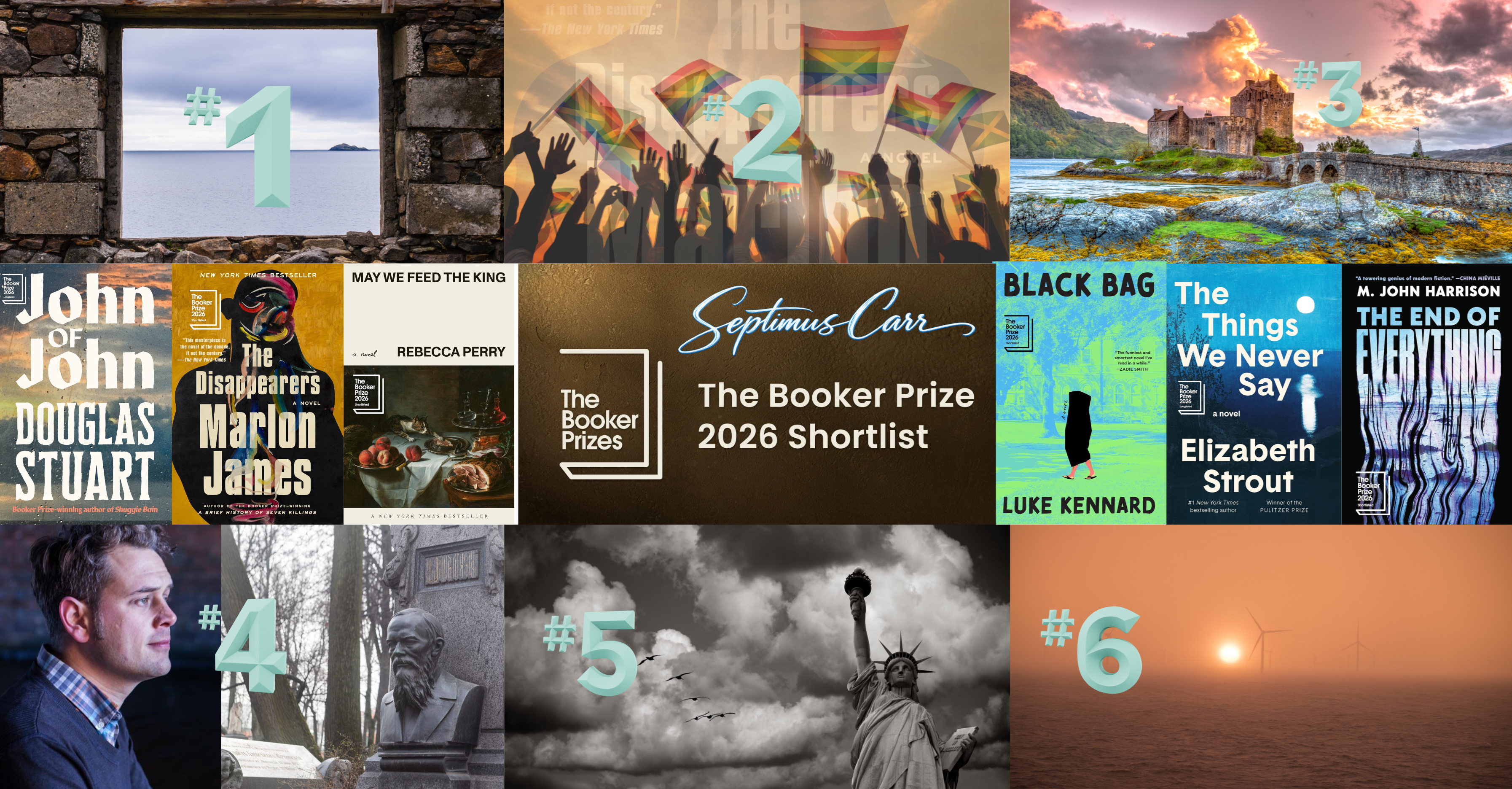
I ranked and reviewed each of the shortlisted novels. I also paired each novel with a classic. The winner of the 2026 Booker Prize was announced November 9, 2026 at 9:45 PM GMT. You can watch the recording of the ceremony at The Booker Prizes YouTube Channel.
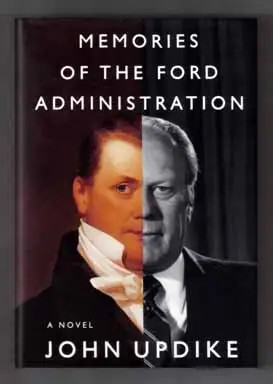
John Updike’s Memories of the Ford Administration is not a classic, it’s probably not his best work, and it’s not even really about the Ford Administration. But its 19th-century history parallels Rebecca Perry’s medieval “history” so closely that it helps illuminate her achievement.
The Narrators
The point, though, I said, the whole point was that I needed a safeguard against certainty—I could not be permitted to create a definitive story for my King, setting him firmly in a history bent to my desires. Rebecca Perry, May We Feed the King
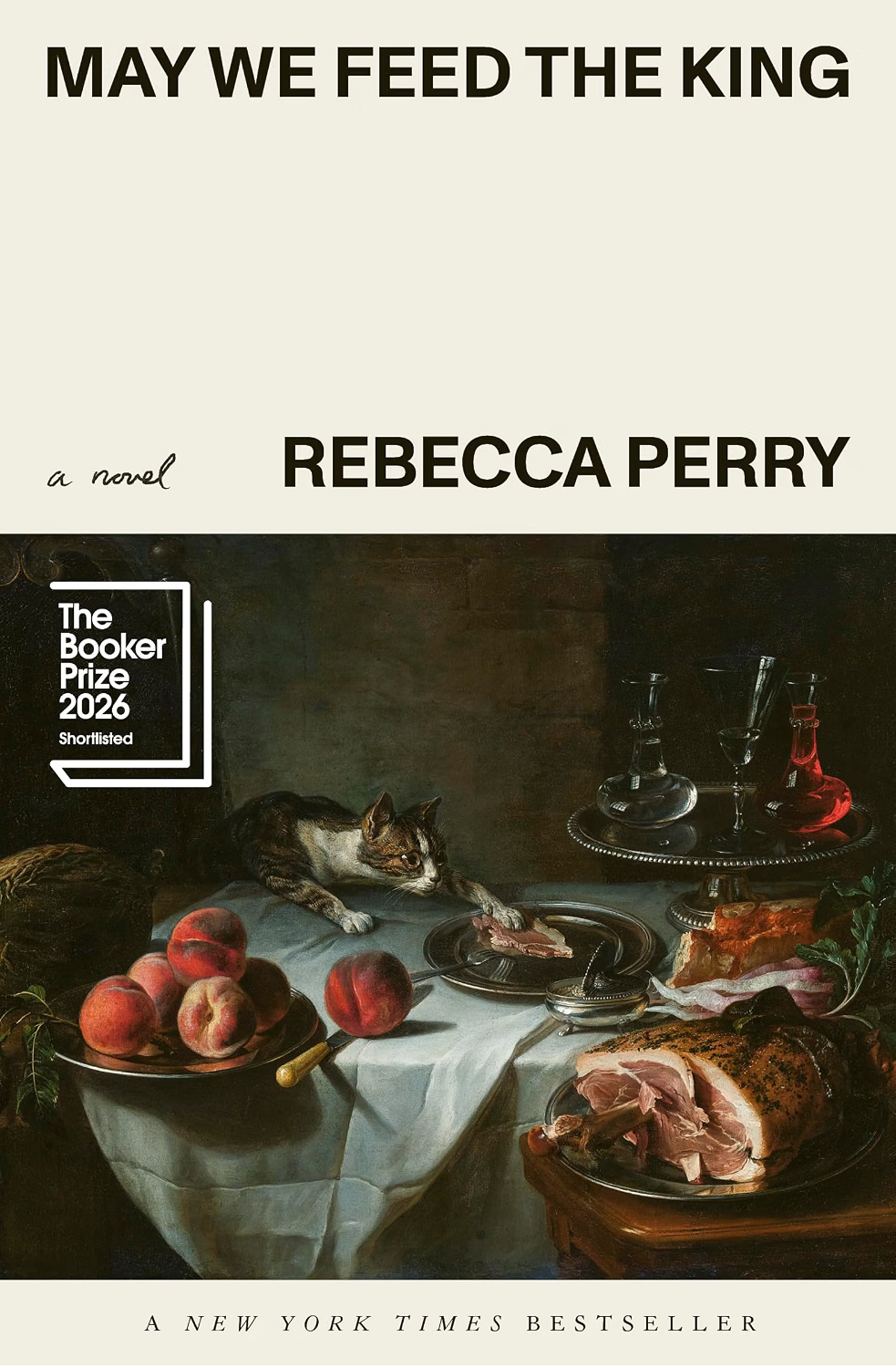
The narrator of Rebecca Perry’s Booker-shortlisted novel May We Feed the King curates archival items, such as food and furniture, for museums and historical sites. The curator’s current assignment is a palace that has hosted centuries of kings and queens. The props selected for this scene will live in the minds of site visitors long after their anachronistic vehicles pull out of the cordoned parking lot, so the curator has a responsibility to deposit honesty in the royal bedchambers. “The chair pushed under the desk, the candles startlingly upright, burnt down a third. Peeking from the pages of a book of prayers is a pressed copper birch leaf, used to mark the page.”
The book, the leaf, the chair, the candle, each is a data point from which a revealing graph may be constructed. So the narrator’s peculiar task is to tell the Truth, and Nothing But the Truth, but the Whole Truth is pie-in-the-sky. The curator is Valentine in Tom Stoppard’s Arcadia, feeding gamebook statistics about hunted grouse into a computer capable of synthesizing them into supportable patterns. These are not just the governing principles of the curator’s palace project. They are the North Star of Perry’s elliptical story. Perry defies storytelling conventions, but to what end? And to what degree of Booker-season achievement?
He spoke, though less than half a generation younger than I, with the brash authority of the New Thinking; gray heads bowed and made way, in this quaint institution devoted to the interim care of well-bred, well-off girls en route from their fathers to their husbands, for “studies” whose ideal texts were the diaries, where they could be found, of black female slaves. He was active, dynamic, persuasive, and committed. He took teaching too seriously, it seemed to me—as a species of political activity, as an opportunity for the exercise of power, even while decrying the white male power of bygone generations. John Updike, Memories of the Ford Administration
The narrator of John Updike’s Memories of the Ford Administration is Alfred Clayton, a historian who can’t resist drawing patterns from his data. He shares the curator’s distrust of certainty, which swaggers presumptuously in the historical analysis of his revisionist colleague Brent, whom Clayton is openly cuckolding. That indiscreet data point is inextricable from Clayton’s curation of the life of America’s 15th President, James Buchanan, which is itself inextricable from the ethos that surrounds the 38th President, Gerald Ford. Pattern is drawn from pattern with nary a chapter break, and no data point goes uninterpreted. “I can’t finish the damn Buchanan book is that I have too much to say,” is simultaneous pillow talk with Brent’s bride and part of the book Clayton can’t finish. “And yet nothing really new. Just the old facts, churned up again.”
The data points that comprise May We Feed the King are plotted in striking juxtaposition to those from Memories of the Ford Administration. They are not telling the same story, but their methods and achievements bear a shocking symmetry. In the exacting light of Updike’s 1992 novel, Perry’s is revealed to be a sparkling elliptical verse portrait of an iconoclastic political family. The framing material that attempts to characterize its own achievement, however, does not hold up to the scrutiny afforded by illumination.
The Subjects
The curator needs to choose a King for the exhibitions to focus on, settling on one with a complex legacy.
Elsewhere, in the dark of corridors and in the shade of the gardens, whispers begin to circulate thus:The King is seeking to absolve himself of his duties.
He makes inquiries to people who owe him no loyalty. Idiot man.
No doubt he has designs to make off in plain sight, to great fanfare, on a horse decked in gold cloth.
No doubt he thinks he can get away with anything.
By what authority? By what authority does he believe he may refuse the throne? Rebecca Perry, May We Feed the King
The King’s advisors murmur dissension. Rebel forces cluster on the horizon. Perry resists the temptation to issue statements of authorial approval or condemnation of her iconoclastic monarch, but her portrayal is endowed with implicit compassion, even admiration for the very eccentricity that threatens his regime. The King is ambivalent about his power. He would rather be tolerant than dominant, honest than safe. He becomes increasingly impatient with obligation to conceal his taste for carnal comforts. Although he ultimately leans on the privilege of exalted position, he does so to preserve ordinary autonomy, not privilege for its own sake. That may not be the hallmark of an exceptional leader, but it is the least we can ask of a human being.
Alfred Clayton’s chosen subject is the consensus choice for the worst president in U.S. history. His unwillingness to hold the South accountable for slavery or for its secessionist demands has resulted in last-place finishes in each of the last four election-year Presidential Historians Surveys hosted by C-SPAN. In 2021, he was one of only three presidents to rank below Donald Trump.
Clayton can’t seem to decide if Buchanan is a historical guilty pleasure or a figure worth rescuing from his own flaws.
I volunteered, “I probably don’t want to finish it. I’m scared of being separated from him.” “From Buchanan?” she said, in genuine surprise. We could still surprise each other; that was nice. “Yes. I love him,” I said. … “Is he lovable?” she sensibly asked. “Not very,” I admitted, then backtracked, “but yes, very. He was stiff and conscientious and cautious. His Presidential addresses are so dry you could learn to hate him. But then you don’t, you get to feel a mind underneath the words, making sense, trying to pull off a balancing act.” John Updike, Memories of the Ford Administration
Clayton’s capacity for nuance comes close to making Buchanan sympathetic in the way that William Shakespeare’s Richard II is sympathetic—as a decent man whose gifts are common—not as the divinely elevated servant of the people. The narrative reconstruction of 19th century politics that Clayton compiles for us fails to vindicate Lincoln’s predecessor from the dustbin of history.
The Pacifism
The King lacks not only the certainty of his royal brothers but also their bloodlust. He mourns the loss of men he has sentenced to death at the behest of his underlings. Even when opposing forces mass on the borders of his reign, the King wants to make peace with them at any cost.
President Buchanan has never lost an election, and he owes his success to his Southern allies. He attempts to check their bellicose agenda, but his pitch has more whine than wind-up.
These men had been his friends and political allies a few weeks ago, solid congenial men with whom, save for a few trifling matters such as the sacred status of slavery, he had no disagreements. It now seemed that that had been an illusion. These men were willing to sink his Presidency and douse Anderson and his troops in blood. John Updike, Memories of the Ford Administration
“History loves blood,” Clayton writes. “It loves the great blood-spillers. Poor Buchanan was ahead of his time, trying to bring mankind up a notch, out of the blood.” The irony of this joint reading of Updike and Perry is that Clayton’s defense of Buchanan is convincing when applied to Perry’s King. Perry offers no circumstances that would mitigate the barbarity of mass violence—right up to the moment that her royal family employ violence to extricate themselves from their inherited elevation. Perry’s sudden flash of liberating bloodshed is a stunning narrative coup, and we cheer the King and Queen even as we recognize the selfishness of the act. But we recognize the personal cost of inaction and principled restraint to the royal family.
By contrast, the attempt of Updike’s hero to invoke pacifism as a Not Guilty plea on Buchanan’s behalf is implicitly rejected by Updike himself. The defense attorney, Clayton, is himself weak and morally compromised. He forgives Buchanan as readily as he forgives himself. Clayton is a callous homewrecker, and even his intellectual integrity is compromised; he condescendingly critiques a feminist student on the grounds that her critique of William McKinley’s phallocentric Imperialism turns him on. After all, the scarcely postadolescent feminist is hot, and she keeps talking about dicks. Who could blame him? It’s not like this happened after Jimmy Carter’s evangelism doused his libido in energy-efficient cold water.
By the same token, Clayton can’t exonerate Buchanan because he is humane. We know exactly how humane a victorious Confederacy would be if it were allowed to prevail. Updike the prosecutor rests his case without even rebutting Clayton. The defense, as mounted, is inadequate for serious consideration by educated readers.
The Sexual Mysteries
The King’s subjects don’t know what to make of his sexual appetites, which often spill out in public but never yield an heir. His relationship with his Queen is burdensomely complex. She has had a lover since before they were married, and he seems to approve of their unofficial union. But on sleepless nights, he begs her to act as a sexual sedative and she willingly obliges. Then, a rumor emerges that might explain it all.
Rumor is that, while innocently walking through the gardens, the Queen’s maid-of-honor chanced upon a window—a beautiful window shaped like an almond— and framed in that window was the young Attendant leaning back upon a table, cock in the mouth of the King, who knelt before him on the floor. What was she to do, in her shock, but run to the other ladies and tell them what she had seen in great detail—how the young Attendant had his eyes closed and his mouth open while the King was looking up at him, imploring. Rebecca Perry, May We Feed the King
Buchanan is the picture of Victorian respectability, even across the Atlantic from Victoria, but his love life, too, prompts whispers, giggles, and pointed fingers. Buchanan is the only U.S. president who never married. Many modern observers prefer to explain Buchanan’s marital status with the love that dare not speak its name. After all, he lived for several years with another man, the future Vice President William Rufus King. Even in the Don’t-Say-Gay ethos of the 1800s, there was open suspicion that Buchanan and King might have had a relationship that was more Oscar and Bosie than Felix and Oscar. Alpha male Andrew Jackson sneeringly referred to them as “Miss Nancy and Aunt Fancy.”
Updike is open to the idea, but Clayton’s assessment in the novel hardly waves any rainbow flags.
American gays, having seized as theirs Whitman, Melville, and Henry James, among our crusty, straight-lipped Presidents must be satisfied with Buchanan, our only never-married chief executive, who in the heat of 1860 was characterized thus by a calumnious but not unpoetic pro-Douglas paper: Mr. B. has a shrill, almost female voice, and wholly beardless cheeks. John Updike, Memories of the Ford Administration
Meanwhile, Updike builds a convincing case that Buchanan’s early fiancé Ann Coleman, who passed away shortly after sending him a haughty Dear John letter that condemned his friendships with other women, was the love of his life. As usual Clayton’s analysis is suspiciously self-serving. When the horny historian meets a young woman named Ann, we realize that he himself harbors a posthumous crush on James’s girl.
The Verdicts
Perry is a newly minted novelist, which means that her prose has not yet been flattened by diligent application of craft. She casually casts off the obligation of clean plot resolutions and authentic dialogue. There is genuinely an engaging freshness to her disregard for fiction’s baseline demands. Perry gets away with it for the most part because she is a gifted poet with T.S. Eliot Prize credentials. Her emphasis on ornamented ambiguity is charming, even substantive. Her language has a musicality and a pregnant expansion of meaning that give the chapters about the King vivid resonance.
But as a writer of historical fiction, Perry is also a poet, and the two are not as easily reconciled. She wants her accumulated data points to substitute for overt interpretation. Her focus on seeing the Royals through the eyes of their servants, particularly the attendant who plays Monica Lewinsky to the King’s Bill Clinton, vaguely recalls the bottom-up historiography of Howard Zinn (A People’s History of the United States). Zinn preferred the accounts of marginalized everymen to those of Great Men.
Clayton’s neologism, “New Thinking,” implicitly denigrates Zinn by suggesting Brent’s students are plundering slave diaries for insights that pale in relevance and drama to his Buchanan book. But his main objection to his rival is that Brent practices the “Dark Art” of deconstruction. Clayton is in the camp that resists the application of modern moral value systems to the past. Updike’s own view on this is oblique, but one suspects that he reflexivley thrills to Clayton’s history-as-novel dramatizations while recognizing the timeless universality of some modern morality.
I too find Updike’s freeflowing fusion of history and fiction thrilling, and I am equally awed by the empathetic complexity of Perry’s medieval characters. I am less convinced, however, that the framing device quite works.
His great gift to us—or at least it has been a gift to me—is the very lack of an ending, that could drive a historian mad. What a great—pardon my language—”fuck you” to everyone who tries to manhandle ambiguity into order, to knock out the air. To the people that have since pinned him down so cruelly and unambiguously on this page. Rebecca Perry, May We Feed the King
This paragraph is presented as a thesis that ties the central historical narrative to the curator and those meticulous data points. The first time I read that paragraph, I somehow misread Perry’s “fuck you” to historical certainty as something closer to fuck you to small-minded condemnations of the King’s iconoclastic values. I am disappointed to learn that Perry is resolving on a statement about archival process rather than thematic substance.
But here’s a question for the ages: Are authorial interviews a component of artistic achievement? If so, I find the work is burnished by Perry’s repeated assertions in periodicals such as Waterstones that her book was written at a time “of particular global horror—the ongoing genocide in Gaza with Netanyahu at the helm, backed by a cast of chilling supporters in Trump and Putin, and not least our own government.”
I’m not sure I see that in the vivid invocations of pomegranates and saffron or even in the King’s decidedly anti-authoritarian laissez-faire governance. But now that she mentions it, I can interpret her “fuck you” as a rejection of Trumpian whitewashing of history—the removal of Black icons from museums, the repeated ghastly assertion of 1776 as amelioration of 1619, the attempt to relieve libraries of their troublesome Toni Morrison novels. Fuck you, indeed. But is that “particular global horror” conjured by the sonorous but timid phrase “manhandle ambiguity into order”?
Perry the Poet resists specificity in her fiction. Her narrator makes claims to personal growth that are utterly undemonstrated by the narrative: “At this point, certain things had happened in my life. I was ready to immerse myself.” “My situation, the pain of it, was something I had no choice but to exist within.” Well, Rebecca, as a critic who frequently incorporates personal anecdotes into his reviews, let me shift into personal essay mode:
When I was younger than I am now, some stuff happened that left me in an undisclosed state—forever!
The language of poetry need not name every data point that lurks behind an earned evocation of sorrow or menace. A pomegranate can fling open the casket of unexamined grief. A whiff of saffron can raze a palace and let loose the ghosts of Gaza.
The portrait in May We Feed the King of luxuriant power yearning for the peace of everyday oblivion did that for me.
Updike’s ambient layering of late ‘70s permissiveness upon a nation of long-shackled rage lurching toward Civil combustion, that did it for me, too.
I just wish the theoretical curation of data points did it for me as well.
| 6th Place | |
|---|---|
| Contestant | The End of Everything by M. John Harrison |
| My Review | Imprecise Peculiarity and Painstaking Banality at The End of Everything |
| Summary | I enjoyed Harrison’s indulgent weirdness at times, but I wondered why he seemed to conceal his freak flag while rambling on ad nauseum about modern suburban settings. |
| Classic Pairing | The Hitchhiker’s Guide to the Galaxy by Douglas Adams |
| Why | Tonally miles apart, but both create apocalyptic futures with aliens who flippantly offer replacements for our core humanity. |
| 5th Place | |
| Contestant | The Things We Never Say by Elizabeth Strout |
| My Review | Elizabeth Strout Tries the Patience of a Saint |
| Summary | Bold in its politics but mild in its artistic ambition. |
| Classic Pairing | Middlemarch by George Eliot |
| Why | Both present their protagonists as everyday saints and use recent political events as backdrops. Both divided readers along generational lines. |
| 4th Place | |
| Contestant | Black Bag by Luke Kennard |
| My Review | The Alphas, Betas, and Gammas of Masculinity in Black Bag |
| Summary | Every hilarious page serves its narrative throughline about what has become of straight male identity in the wake of feminist reckonings. |
| Classic Pairing | The Double by Fyodor Dostoevsky |
| Why | Kennard’s story begins to realize its surreal potential when Black Bag chases down his Double. The authors both cozy the reader with familiarity before things get weird. |
| 3rd Place | |
| Contestant | May We Feed the King by Rebecca Perry |
| My Review | The Poet as Novelist and Historian in May We Feed the King |
| Summary | The first novel by an experienced poet has an evocative core but an uneven historiological frame. |
| Classic Pairing | Memories of the Ford Administration by John Updike |
| Why | The parallels between Perry’s hated monarch and Updike’s reconstruction of James Buchanan, by consensus the worst president in U.S. history, illuminate May We Feed the King in numerous ways. |
| 2nd Place | |
| Contestant | The Disappearers by Marlon James |
| My Review | Is The Disappearers the Beloved of the Gay Experience? |
| Summary | Marlon James's voice is distinctively and historically queer in its quicksilver wit, its showy intellect, and its unfailingly compassionate resilience. It flies defiantly against unremitting gales of bigotry, in unflinching affirmation of a people who refuse to spend another day hiding from themselves. |
| Classic Pairing | Beloved by Toni Morrison |
| Why | Beloved is as close as Morrison comes to a definitive statement on slavery, which haunts all of her works. The Disappearers is a comprehensive exploration of the gay experience in homophobic Jamaica. Beloved is the fullest realization of Toni Morrison’s life’s work and the lasting community touchstone that Marlon James is reaching for. |
| 1st Place | |
| Contestant | John of John by Douglas Stuart |
| My Review | Staying is The Longest Journey |
| Summary | In sheer wattage per page, Douglas Stuart’s richly textured, deeply pained, and inerrantly true novel was the most moving and wryly satisfying book of the year. |
| Classic Pairing | The Longest Journey by E.M. Forster |
| Why | The fulfilling acceptance Rickie finds at Cambridge, and his growing skill as a writer, are the stakes of Cal’s sacrificial return to the island. Rickie’s misfit marriage and sham teaching job at Sawston are the island he must leave. And in standing up for himself against Pembroke, Stephen is Innes escaping at last. |